A plumber in Chicago hires an SEO agency. Six months later his blog ranks for “how to fix a leaky faucet,” his traffic is up, and his phone is just as quiet as before. What went wrong? He bought traditional SEO when what he needed was local SEO.
This is one of the most expensive mix-ups in small business marketing. The two sound almost identical, but they target different people, play by different rules, and produce different results. Let us settle it clearly: what is the difference between SEO and local SEO, and which one does your business actually need?
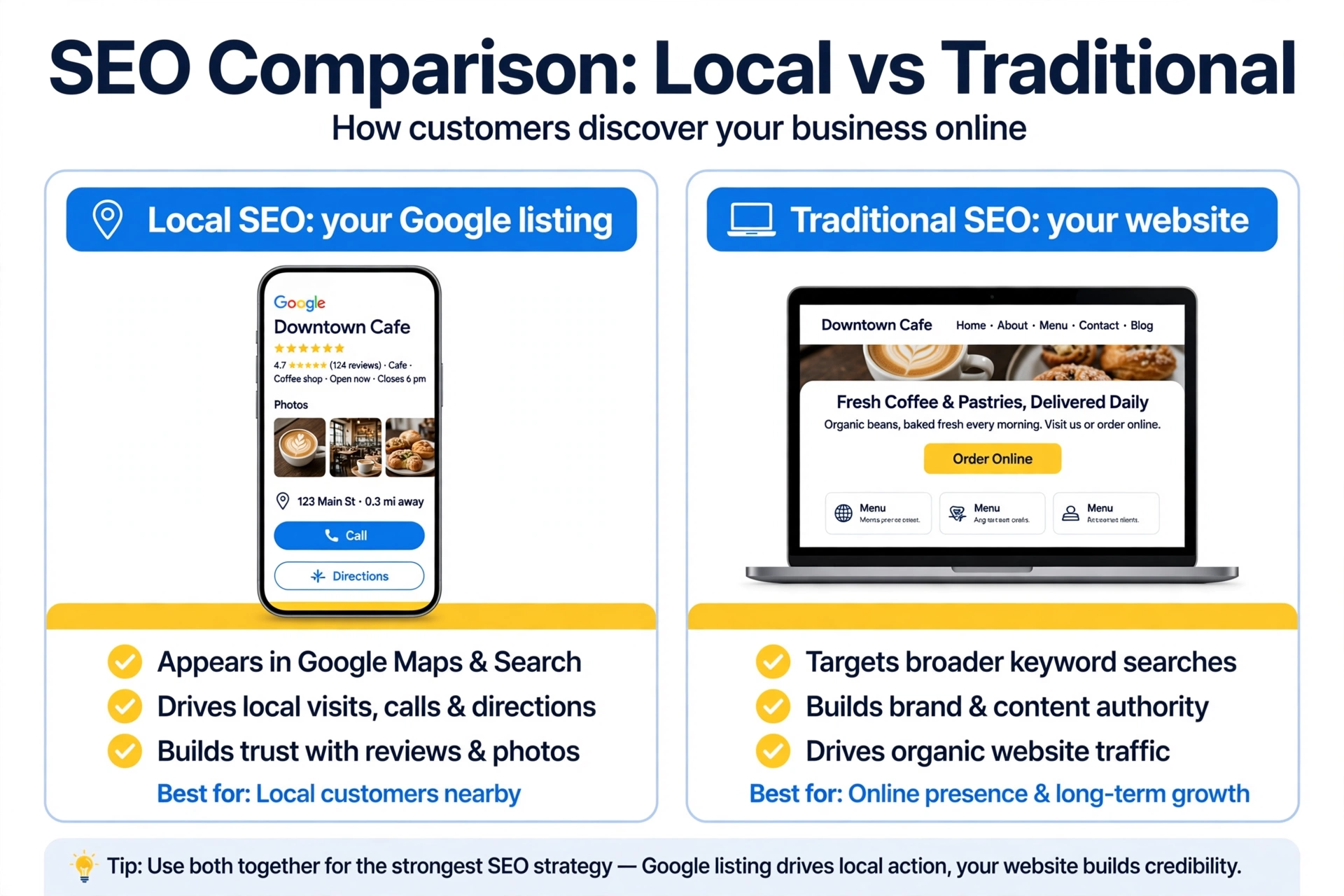
The short answer: Traditional SEO optimizes your website to rank for broad searches from anyone, anywhere. Local SEO optimizes your business to appear for nearby customers searching with local intent, mainly through Google Maps, your Google Business Profile, reviews, and local listings. One builds website traffic; the other drives calls, visits, and sales from people close by.
What Is Traditional SEO?
Traditional SEO, also called organic or national SEO, is the practice of optimizing your website to rank in Google’s standard search results for queries from anyone, anywhere. Think “best project management software,” “how to write a business plan,” or “what is compound interest.” The searcher’s location does not matter; everyone sees roughly the same results.
It works through content quality, backlinks from authoritative sites, technical site health, and expertise signals. The goal is usually traffic, brand authority, and leads at scale. It is the right game for blogs, ecommerce stores, SaaS companies, and anyone selling beyond one city.
What Is Local SEO?
Local SEO is the practice of optimizing your business to appear when nearby customers search with local intent: “plumber near me,” “dentist in Austin,” “emergency electrician open now.” Google detects the geographic intent, sometimes from the words themselves, sometimes from the searcher’s phone location, and shows a completely different set of results.
The centerpiece is not your website. It is your Google Business Profile, supported by reviews, local citations, and location signals. The goal is narrower and sharper: phone calls, bookings, and foot traffic from people ready to buy right now.
What Is the Real Difference Between SEO and Local SEO?
Here is the side-by-side breakdown:
| Factor | Traditional SEO | Local SEO |
|---|---|---|
| Target audience | Anyone, anywhere | Customers near your business |
| Keywords | Broad and informational | Location-based and “near me” |
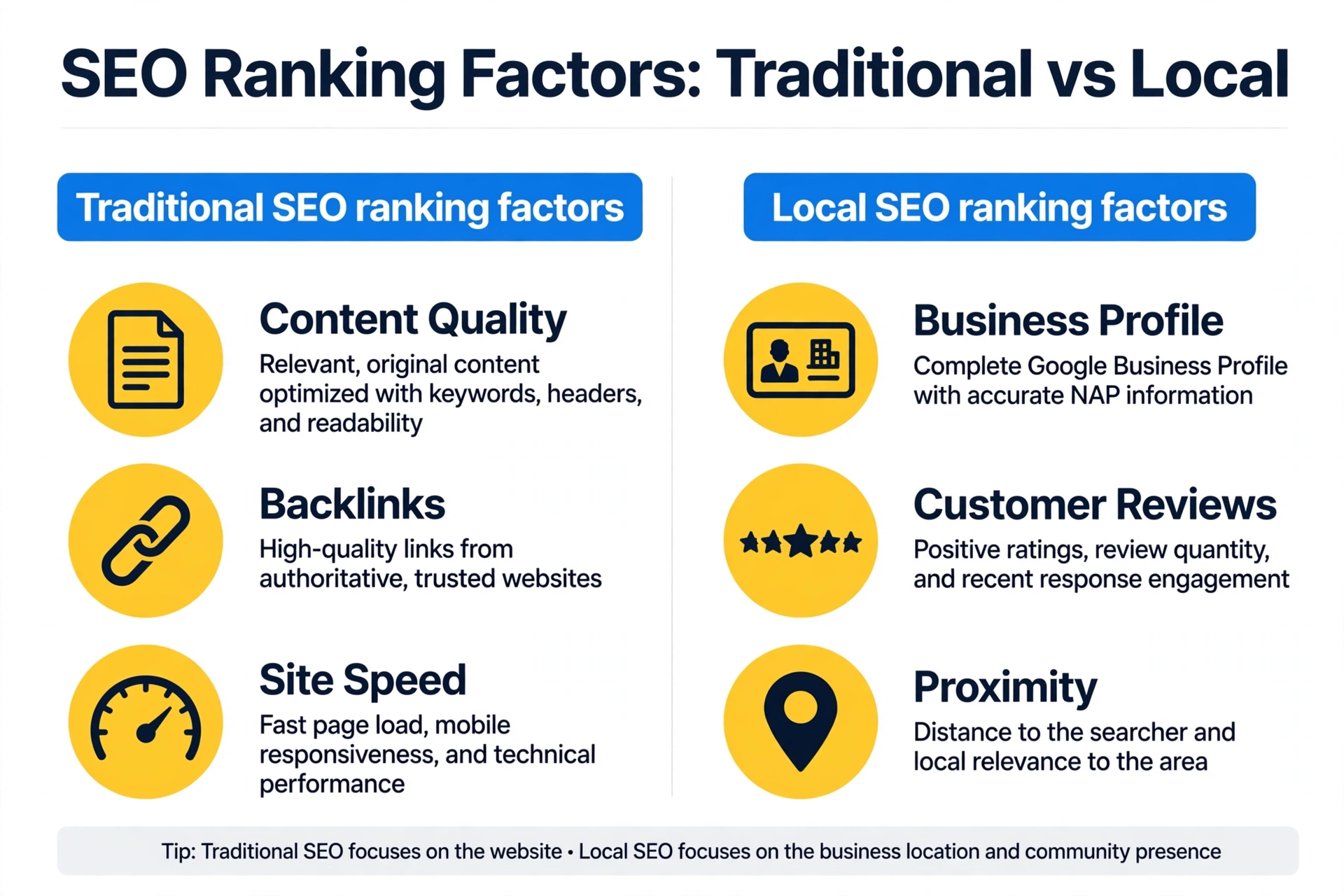
| Main ranking factors | Content, backlinks, technical health | Google Business Profile, reviews, proximity |
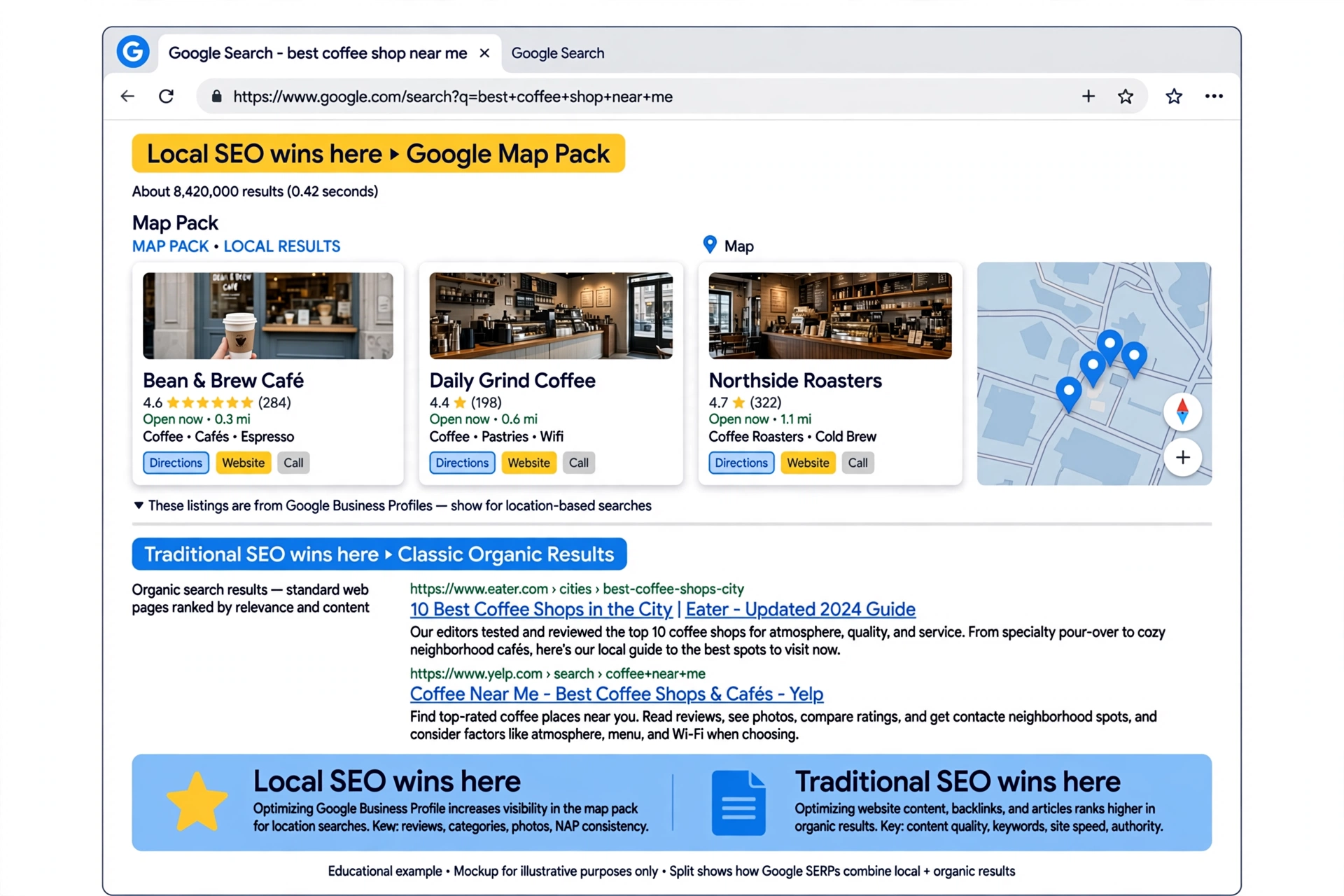
| Where you rank | Organic blue-link results | Map Pack, Maps, local organic results |
| Primary goal | Traffic and authority | Calls, bookings, visits |
| Search intent | Mixed: research and browsing | High: ready to buy |
| Best for | Ecommerce, blogs, national brands | Restaurants, clinics, trades, local shops |
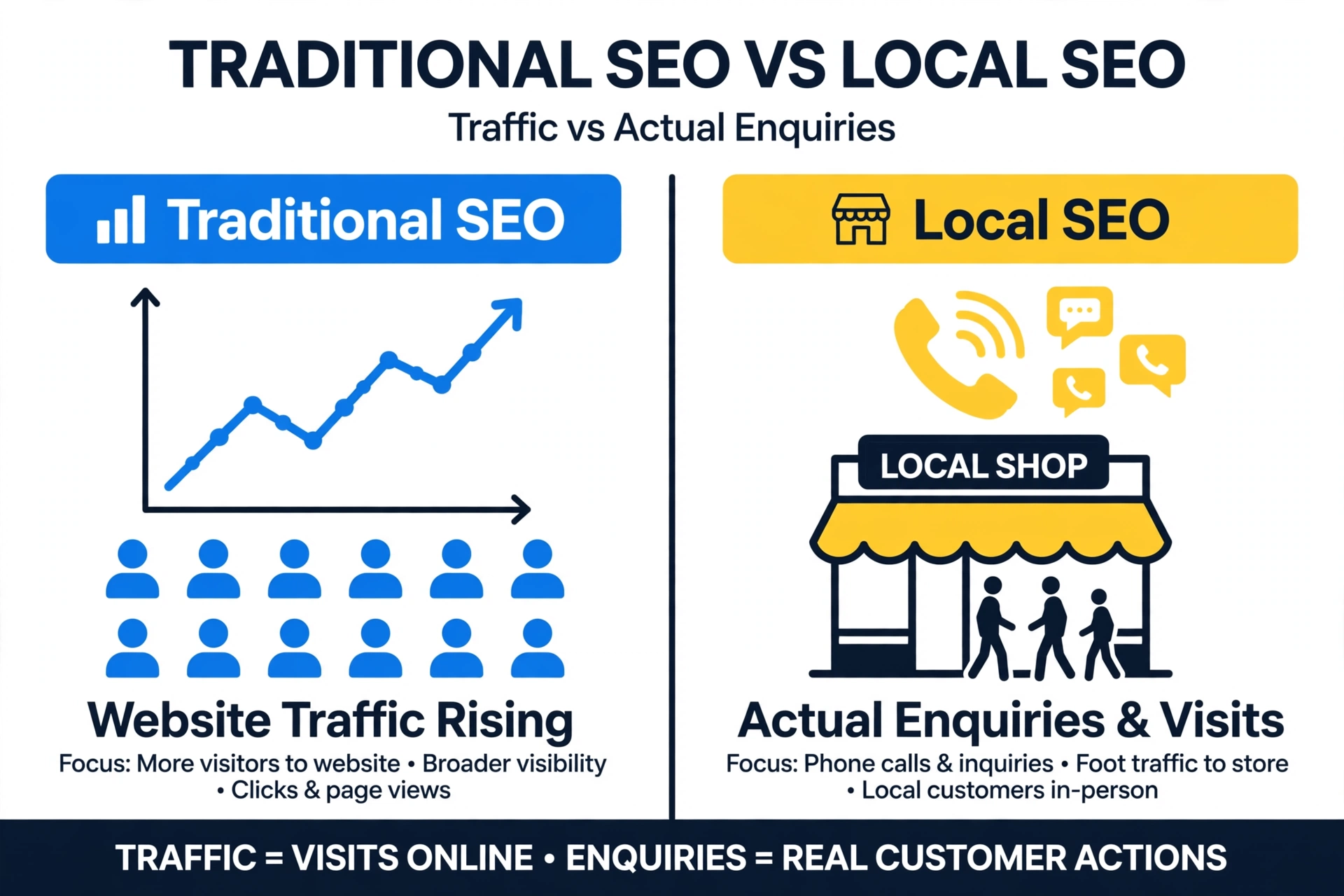
The sharpest way to remember it: traditional SEO is traffic-focused, local SEO is enquiry-focused. Traffic looks great in reports, but it does not pay the bills. A thousand visitors reading your blog is worth less than ten nearby customers calling your business.
How Do Google’s Ranking Systems Differ?
This is the part most guides skip, and it is the most important. Google runs two separate ranking systems. The organic algorithm weighs content quality, E-E-A-T signals, backlink authority, and technical health. The local algorithm weighs three things: proximity, relevance, and prominence.
Their inputs barely overlap. According to Whitespark’s 2026 Local Search Ranking Factors survey, the Map Pack is driven by Google Business Profile signals (32%), review signals (20%), on-page signals (15%), and behavioral signals (9%). Meanwhile local organic results below the pack are driven mostly by on-page signals (33%) and link signals (24%). Same page, different games.
What does this mean in practice? A business with a high-authority website and excellent traditional SEO can still be invisible in the Map Pack if its Google Business Profile is incomplete, its business info is inconsistent, and its reviews are thin. Performance in one system does not transfer to the other.
Which One Does Your Business Actually Need?
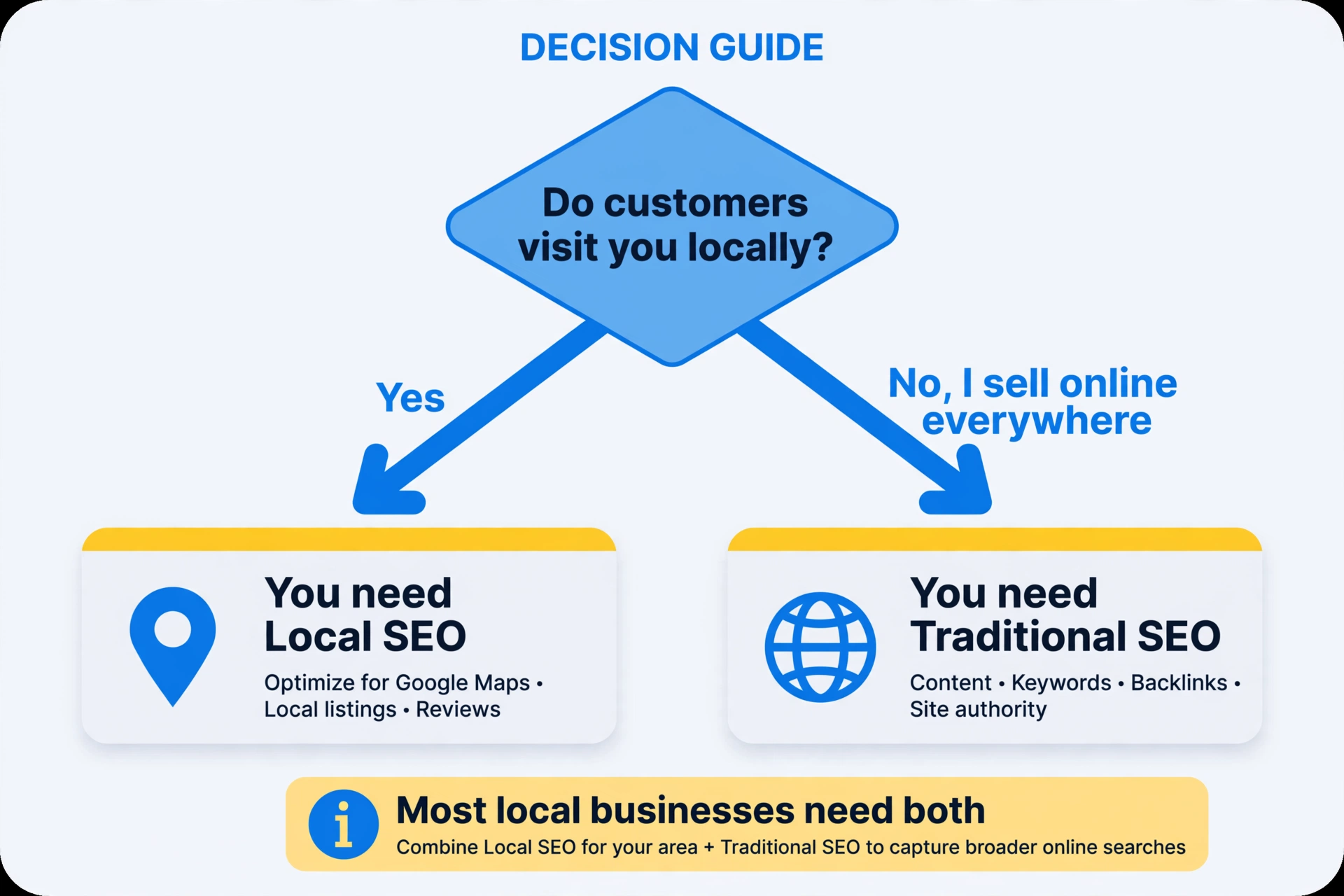
Ask one question: do your customers come to you locally, or do you sell to anyone online?
- You need local SEO first if you are a restaurant, clinic, law firm, plumber, salon, real estate agent, or any business serving a specific area. Your buyers search locally and decide fast.
- You need traditional SEO first if you run an ecommerce store, blog, SaaS product, or national service with no geographic boundary.
- You likely need both if you are a multi-location brand, a franchise, or a local business that also sells online.
For local businesses, the order matters. Local SEO typically delivers enquiries faster because it targets buyers, not browsers. Traditional SEO compounds over a longer period. If your phone needs to ring this quarter, start local.
Can You Do Both at the Same Time?
Yes, and the best strategies do. They just prioritize differently. Your Google Business Profile and review engine come first because they directly move Map Pack rankings, and the Map Pack captures a huge share of local clicks. Your website content supports the effort: service pages for each area you serve give Google more data to match you with local searches.
Meanwhile, broader content builds long-term authority. Guides and educational articles earn organic traffic over time, and that authority quietly lifts every ranking, including local ones. Think of it as two engines: local SEO for revenue now, traditional SEO for growth later. Our local SEO services are designed to run both in the right order.
Will traditional SEO alone rank me locally? Rarely. You can hold position one organically and still miss every Map Pack impression if your business profile is weak. Google treats them as separate contests.
What Mistake Do Most Local Businesses Make?
The classic one: hiring a generic SEO agency that never touches the Google Business Profile. The agency publishes blog posts, tweaks page titles, and chases backlinks from national sites. Six months later the owner ranks for informational keywords nobody buys from, while competitors own the Map Pack. The phone stays quiet.
Red flags when choosing help: the agency never mentions your Google Business Profile, reviews, or citations. It reports traffic growth but not calls or direction requests. It stuffs your city name into every page instead of building genuine local signals. If you are paying for “SEO” and your Map Pack presence has not moved, you are buying the wrong kind.
Does AI Search Change Anything?
It sharpens the divide. AI assistants answer local questions using structured local data: your profile, reviews, citations. They answer general questions using web content. So AI search rewards both disciplines, each in its own lane. A business invisible in local SEO is invisible in AI local answers too, no matter how good its blog is. The fundamentals have not changed; the number of places they matter has grown. Local SEO Rankers watches this shift closely.
To keep learning, start with Google’s SEO Starter Guide and Search Engine Journal’s local SEO guide.
So, Which SEO Does Your Business Need?
SEO and local SEO are not rivals. They are different tools for different jobs. Traditional SEO wins the broad web; local SEO wins the neighborhood. For local businesses, the order is clear: own your Map Pack first, then build outward. Get the right kind of SEO, and the right customers follow.
Not sure which SEO your business needs? Contact Local SEO Rankers for a free audit. We will show you exactly where you stand in both local and organic search, and build the right plan for your market.
Still Have Questions About SEO vs Local SEO?
Is local SEO part of SEO?
Yes. Local SEO is a specialized branch of SEO focused on location-based searches. It uses many traditional SEO basics, like keywords and technical health, then adds local-only signals: your Google Business Profile, reviews, citations, and proximity.
Which is harder: SEO or local SEO?
Traditional SEO is usually harder and slower because you compete nationally or globally. Local SEO competes in a smaller geographic pool, so a well-optimized small business can outrank bigger competitors locally, often within months rather than years.
Can a business rank without a Google Business Profile?
In organic results, yes. In the Map Pack and Google Maps, effectively no. The profile is the entry ticket to local pack rankings, which capture the majority of local clicks.
Do I need a website for local SEO?
Strictly speaking you can rank a Google Business Profile without a website, but you should not. Your website reinforces every local signal, captures the organic positions below the pack, and gives customers somewhere to convert.
How much does local SEO cost compared to traditional SEO?
Local SEO is typically more affordable because the competitive field is smaller. Traditional SEO at national scale demands more content, more links, and more time. Most local businesses see better ROI from local SEO within the first year.
Should I hire a general SEO agency for local SEO?
Only if local search is genuinely part of their process. Ask whether they optimize Google Business Profiles, manage reviews, and fix citations. If their plan is only blogs and backlinks, keep looking.