I run a local shop in Leander, Texas, fixing things for people within about twenty miles of my front door. When I started hearing that a local domain name, one that ends in your country’s letters instead of .com, could help me show up higher on Google, I wanted a straight answer. Just the truth, not a sales pitch.
Short answer: yes, a local domain helps, but not the way most people think. It is a signal, not a shortcut. Google reads it as a clear sign your site belongs to a certain country. It will not save a thin website. The biggest advantage in 2026 is the customer: local people trust a local address more, and they click it more.
The short answer: Yes, a local domain helps, but as a signal, not a shortcut. Google reads a ccTLD as a clear sign your site is for that country, and local people click it more, but it will not rank a weak website, and for several countries one .com with subfolders is usually the smarter call.
So does a local TLD domain help SEO in your country? Yes, if you use it right. No, if you think buying the domain is the whole job.
What Is a Local TLD, Anyway?
Every web address ends with a few letters after the last dot. That ending is called a top-level domain, or TLD. The one you know best is .com. A local TLD belongs to a country. It is called a country-code top-level domain, or ccTLD. The letters match the country: .de is Germany, .fr is France, .co.uk is the United Kingdom.
Think of it like the sign over your shop. A .com sign says you are open to the whole world. A .co.nz sign says you are a New Zealand business, on your street. People read that sign. So does Google.
What does ccTLD mean?
A ccTLD is a two-letter domain ending assigned to a specific country or territory under the ISO 3166-1 standard. There are around 250 of them, including .de, .fr, .co.uk, .co.nz, and .nz. The contrast is a generic top-level domain, or gTLD: .com, .net, and .org. A gTLD carries no country meaning. Google treats it as global, so it gives you no local signal.
Which endings count as local, and which ones only look local?
Not every two-letter ending is a local signal. Some got so popular that Google gave up treating them as country codes. Google now treats these as generic: .ad, .ai, .as, .bz, .cc, .cd, .co, .dj, .fm, .io, .la, .me, .ms, .nu, .sc, .sr, .su, .tv, .tk, and .ws.
Plenty of startups run on .io, and plenty of brands run on .co. They send Google no country signal at all. A .co buys you no local advantage, same with .ai and .me. Check Google’s list, linked below, before you spend a dollar.
Keywords in a domain name barely matter. Google’s SEO Starter Guide says they have hardly any effect beyond breadcrumbs, and Google cut the exact-match benefit for low-quality sites in 2012. A name like aucklandbestplumberdeals.co.nz reads as spam. Your brand name is worth more.
Does a Local TLD Actually Help You Rank in That Country?
Yes. Here is the honest version of how, and how much.
What Google says in plain words
Google’s own documentation says country-code domains “provide a strong signal to both users and search engines that your site is explicitly intended for a certain country.” Google also says geotargeting “can improve your page rankings in the target country, but at the expense of results in other locales or languages.” A .de domain helps you in Germany and hurts you everywhere else.
Google’s John Mueller has put it this way: “For geotargeting we use mostly the ccTLD or Search Console setting.” That setting is gone now.
The trust factor: why local people click local domains
Here is where the real money is. When a customer in France searches for a local plumber and sees a .fr result next to a .com result, they are more likely to click the .fr one. It looks local.
Research reports ccTLDs see 10 to 15 percent higher trust from local users than generic TLDs. A Searchmetrics study of the .berlin city domain found sites using it ranked 1.18 times higher in Berlin local searches than comparable .de or .com sites. In New Zealand, InternetNZ research from 2025 found 74 percent of businesses agreed .nz is more trustworthy than .com, up 16 points since 2020.
Higher trust means more clicks, and more clicks mean better engagement. That is the real path from a local domain to better rankings in 2026.
The honest catch: a domain ending cannot carry a weak website
Here is the part nobody selling domains says out loud. A .de or .co.nz domain will not save a website with thin content, no local links, and no real local information on it. The domain is one signal among many. Google also looks at content, local backlinks, address and phone, currency, language, and Business Profile. A .com done right can rank just as well locally as a ccTLD. A 2026 domain guide puts it plainly: “Google no longer treats a ccTLD as a shortcut to local rankings.”
What Does Google Itself Say About ccTLDs and Geotargeting?
If you only read one source on this topic, read Google’s own page: “Managing Multi-Regional and Multilingual Sites” in Google Search Central.
The locale signals Google reads
- Country-code top-level domains (ccTLDs). The strongest single domain signal. A .de means Germany, a .co.nz means New Zealand.
- Hreflang statements. Tags, headers, or sitemaps that tell Google which language and region version to show each searcher.
- Server location. Where your site is hosted, read from the server’s IP address. Google admits it is not definitive.
- Other signals. Local addresses and phone numbers, local language and currency, links from local sites, and signals from your Business Profile.
Notice what is on that list: your address, phone number, currency, and who links to you. The domain is the loudest signal, but not the only one.
Google says it ignores locational meta tags like geo.position or distribution. Geo meta tags do not boost local rankings.
The change almost every guide misses: Search Console lost its country setting in 2022
For years, Google Search Console had an International Targeting report. It had two tabs: one that checked your hreflang for errors, and one that let you manually set the target country for a whole property.
Google removed that report in September 2022. Google said the value of the manual country setting had decreased over time and that hreflang had matured. The report and the setting are gone.
Why does that matter? If you run a .com with a /de/ subfolder today, there is no button anywhere that tells Google that folder is for Germany. You are left with hreflang and the signals Google infers on its own. An Ahrefs study of 374,756 domains that use hreflang found that over 67 percent got it at least partly wrong.
A ccTLD never needed that setting. The domain ending IS the declaration. Losing the report changed nothing for ccTLDs and changed everything for subfolders.
So when you read an older guide that says “just set your target country in Search Console”, you are reading advice for a tool that has not existed for four years. Check the date on anything you read about this topic.
ccTLD vs Subdomain vs Subdirectory: Which One Wins for Local SEO?
There are three ways to target a country, and every one of them has a cost. The table is the whole story at a glance. The words below it are the part the table cannot show.
| Structure | Example | Country signal | Authority | Cost and upkeep |
|---|---|---|---|---|
| ccTLD | example.de | Automatic, strongest | Split, each domain builds its own | Highest |
| Subdomain | de.example.com | Manual, needs hreflang and local signals | Separate hostname, evaluated per site | Medium |
| Subdirectory | example.com/de/ | Manual, needs hreflang and local signals | Shared, all on one domain | Lowest |
For most local businesses, the subdirectory is the right call. It keeps all your ranking power in one place. Every link helps the whole site. One site to update, one set of analytics, one bill. The only real cost is that you have to do the geotargeting work yourself, with hreflang and local signals, because the domain does not do it for you.
Subdomains sit in the middle and are usually the worst of both worlds for a small business. Google treats a subdomain as a separate property. It builds its own history, and the authority does not flow freely from the main domain. You run two sites for half the payoff.
A 2023 Ahrefs study found ccTLDs have about a 10 percent edge over subdomains or subdirectories in local search, but the advantage largely disappears for strong domains. One well-known 2012 case study compared three Brighton Hotels and found the .co.uk site outranked the equivalent .com by 37 percent. That case is one hotel in one city, fourteen years ago.
The bottom line of the comparison
- ccTLD: the clearest country signal, the highest cost, the most isolation. Your existing domain authority does not transfer. Use it when one country is your whole business and you are in for years.
- Subdomain: the weakest middle option. Google treats it as a separate property. Only use it when the content per country is genuinely different, like different products or different laws.
- Subdirectory: the lowest cost, the most shared authority, the weakest built-in signal. You make up the difference with hreflang and local signals. For most small businesses, this is the right call.
When Does a Local TLD Hurt More Than It Helps?
Short answer: when your customers live in more than one country.
The one-country trap
A ccTLD is a promise that you are for that country, and Google holds you to it. Your .de site ranks in Germany and fades everywhere else. If your customers live in two or three countries, one ccTLD starves the other markets. The domain that wins Germany is the same domain that loses you Austria, Switzerland, and everyone searching in English.
The hidden costs nobody mentions up front
Some ccTLDs are cheap and open, others are not. Some registries require a local address, a local tax number, or a business registration in that country. Some domains carry renewal prices that are several times the cost of a .com, and the renewal can go up without notice. Run the numbers for five years, not one.
Moving to a ccTLD from an existing domain
Switching domains is the most dangerous SEO move most businesses ever make. You are moving your whole house to a new street and hoping everyone finds it. Plan the redirects page by page, keep the old domain registered for at least two years, and expect rankings to dip for weeks to months even when the migration is done well.
What About AI Search? Do ChatGPT and Google AI Overviews Care About Your Domain Ending?
Search has split in two. Customers ask ChatGPT and read AI Overviews before they click a link. Does a local domain help in AI search too?
What AI engines actually use to pick sources
Short answer: no, not the way Google does. ChatGPT, Perplexity, and Google’s AI Overviews do not rely on hreflang or ccTLDs to serve regional results. They retrieve pages and build an answer from the sources that best match the question. What they care about is a clear, consistent, citable entity: same name, same address, same phone number everywhere.
That means a .co.nz domain does not make ChatGPT cite you. A .com with clean data, a proper FAQ, and consistent business information can get cited while a ccTLD with thin content gets ignored. The domain ending is a Google signal, not an AI signal.
- Consistent business data everywhere. Your name, address, and phone number must match exactly across your website, your Business Profile, and every directory. AI models pull from patterns of consistent data.
- Schema markup that matches what visitors see. LocalBusiness, FAQPage, and Service schema tell machines what your content means.
- Content that answers real questions directly. FAQ content built around the questions customers actually ask, answered in plain words, is the format AI engines lift most easily. That is AEO, answer engine optimisation.
- Local citations and links. Mentions of your business on local directories and real local sites confirm you are a real business in a real place. That is the same work as local SEO.
If you want this handled properly, that is exactly what Local SEO Rankers’ AEO and GEO service does: it builds your business into the answers ChatGPT, Perplexity, and Google AI Overviews give, with schema, FAQ content, and monthly tracking. Most businesses see early AI Overview appearances within 60 to 90 days.
Location still matters enormously, just not through the domain
Location absolutely changes what AI engines say. One study ran the same 32 home-services questions in 100 metro areas across four AI engines over 28 days, analysing 356,019 citations. The share of citations going to directories ran from 12.3 percent in Toronto to 34.6 percent in Oakland. The lever is location context, local content, and local sources, not the domain ending.
Zero-click searches rose from 56 percent to 69 percent in the twelve months after AI Overviews launched. Ranking in blue links is no longer enough. You have to be the business the answer names. Seer Interactive data shows visitors from ChatGPT converted at 15.9 percent and from Perplexity at 10.5 percent, against 1.76 percent for classic organic search. A local domain does not win them. Being a clear, trusted, citable local entity does.
The New Zealand Angle: .co.nz vs .nz vs .com
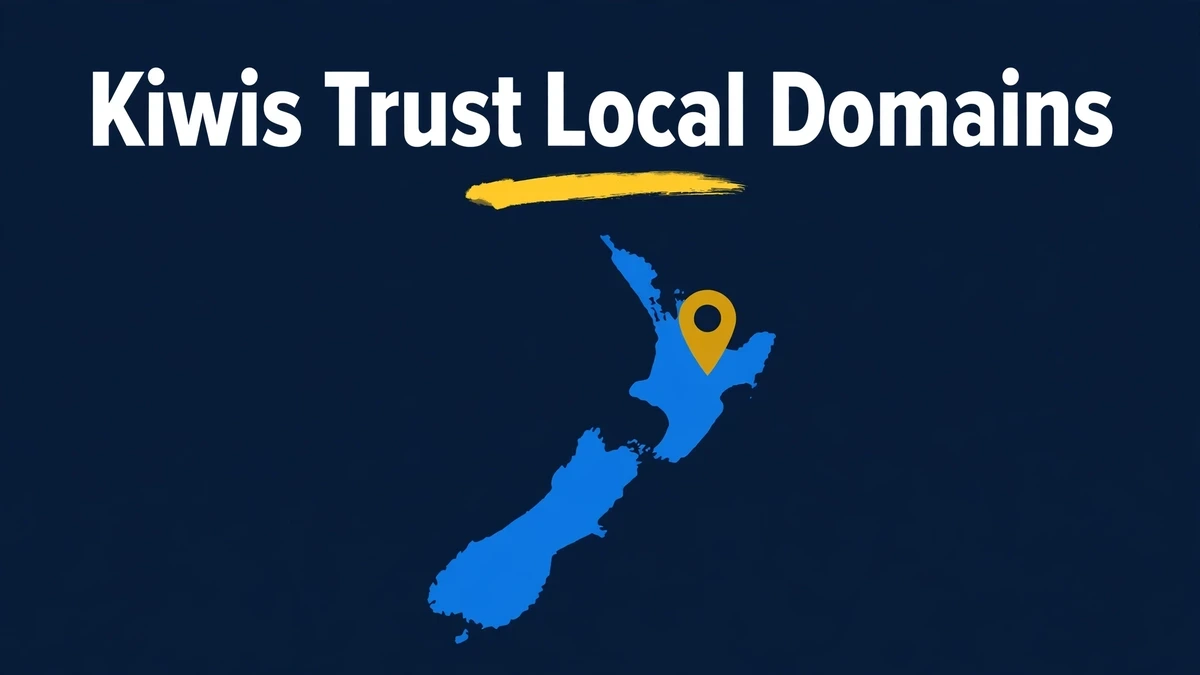
Most of this guide applies anywhere, but New Zealand deserves its own section. Trust is the whole ball game here, and Kiwis trust .nz.
The trust data
InternetNZ research from 2025 found that 74 percent of New Zealand businesses agreed .nz is more trustworthy than alternatives such as .com, up 16 percentage points since 2020. Kiwi shoppers show the same pattern. They prefer .nz for local purchases, they trust local businesses more when the web address matches the country, and they are more likely to click a .nz result for a local search. That trust is worth real money.
The .nz namespace is growing
There were 790,785 registered .nz domain names in September 2026, with growth in .nz direct registrations and in shorter, brandable names. The .nz namespace is not shrinking. It is consolidating around the shortest, most direct names.
Both .co.nz and .nz are equally local in Google’s eyes. The difference is human, not technical. The .nz ending is shorter, cleaner, and more memorable, and that matters when a customer types your address from memory. New registrations trend toward .nz, while .co.nz remains the most recognised and trusted form. If you can get your brand in .nz, take it.
What this means for you, in plain words
If you are a New Zealand business serving New Zealand customers, a .nz or .co.nz domain is worth having. Keep your .com too, and redirect it.
Local SEO Rankers’ citations and link building service builds the local mentions and links that confirm to Google you are a real business in a real place. Aim for 20 to 30 quality citations, not 500 blasts.
Should You Switch to a Local TLD? A Straight Decision Guide
Here is the decision, boiled down.
- Stay with .com and add a subdirectory if your customers are mostly local but you also serve other countries, or if your budget is tight. A subdirectory like example.com/nz/ keeps all your authority in one place and lets you target the country with hreflang and local signals instead.
- Switch to a local TLD if your whole business is in one country, you have no plans to expand, and the trust and country signal matter more than the cost of starting from zero.
- Buy the local TLD and redirect it to your main site if you are not ready to switch yet but want to protect your brand. Park it, point it at your main site, and keep your options open.
- Run a hybrid setup if you are a larger business with different products or different laws per country. One .com for the global brand, local ccTLDs for the markets that matter most. Expensive, but the cleanest at scale.
If you already rank well on a .com, do not move for a small signal gain. The domain ending is one signal among many, and a site that already ranks has already proved it can win without it.
If you are a brand-new business, the choice is easier. You have no rankings to lose. Pick the domain that matches where your customers are, and start building from day one. If you want that foundation built properly, Local SEO Rankers’ local SEO service covers exactly that: profile, website, and citations.
Still not sure? If your customers all live in one country and you have no plans to leave it, buy the local TLD.
How to Make a Local TLD Work (If You Choose One)
Buying the domain is the easy part. Making it work is the job.
A ccTLD on its own is a sign with nothing behind it. Pair it with a complete and active Google Business Profile with the right categories, photos, posts, and review responses.
- Keep all your locale signals pointing the same way. Your address, your phone number, your currency, your language, and the local links pointing to your site should all agree on the country. One stray signal can confuse the picture.
- Get your hreflang right. If you run multiple versions of your site, hreflang tells Google which version belongs to which audience. Two out of three sites get this wrong, so check it with a validator.
- Protect the brand. Buy the matching .com and any obvious variants, and redirect them to your main domain, so a competitor cannot squat on your name.
Frequently Asked Questions
Does having a local TLD domain help SEO in your country?
Yes, for ranking in that country. A local TLD is a strong country signal and builds trust with local customers. It is not a shortcut: content and local links still decide your rankings.
Can I target more than one country with a ccTLD?
No. A ccTLD targets a single country by design. A .de helps you in Germany and hurts you elsewhere. Use subdirectories with hreflang if you serve several countries.
Do I need to buy a ccTLD if my business is only local?
No. A .com with a subdirectory, correct hreflang, local content, and a Google Business Profile can rank just as well. A ccTLD adds trust and a stronger signal.
Will switching to a local TLD hurt my rankings?
It can, for weeks to months. A migration needs page-by-page redirects and keeping the old domain registered. Expect a dip even when the move is done well.
Does a local TLD help with AI search?
Not directly. ChatGPT, Perplexity, and AI Overviews do not use ccTLDs to pick sources. They cite clear, consistent, citable entities: matching business data, schema, and direct answers.
Is .nz better than .co.nz?
Both send the same local signal to Google. The difference is human: .nz is shorter and more memorable, while .co.nz is more recognised.
Can I use a subdomain instead of a ccTLD?
Yes, but Google treats a subdomain as a separate property. For most small businesses a subdirectory is the better call: it shares authority with the main domain.
Do geo meta tags help local SEO?
No. Google says it ignores locational meta tags like geo.position. Real local signals are your address, phone number, currency, and local links.
How much does a ccTLD cost?
It varies by country. Some are cheap and open, others need a local address or business registration and cost several times a .com.
Should I buy the local TLD even if I stay on .com?
Yes. Buy it and redirect it to your main site. It protects your brand, stops a competitor squatting on your name, and keeps your options open.
Bottom Line: The Sign Helps, But the Shop Does the Work
A local TLD domain helps SEO in your country. It is a strong country signal for Google, and it earns trust from local customers who click it more. But it is not a shortcut, and it is not a substitute for doing the work.
The domain ending is the sign over your shop. The shop is the thing that has to be good. Local content, local links, consistent business information, and a Google Business Profile that matches it all: that is what ranks you. The sign helps people find the door.
If you want help deciding, or help making the move without losing your rankings, that is what I do. Reach me on WhatsApp at +92 336 0378683, email hello@localseorankers.com, or visit localseorankers.com and tell me where your customers are. I will tell you straight whether a local TLD is worth it for you.