
You know what you sell. Your customers know what they need. The problem is you both say it differently, and Google only shows businesses that speak the customer’s language.
That is what local keyword research fixes. It is the process of discovering the exact phrases people in your area type into Google, then making sure your business is the one they find. This guide shows you how to do it, free tools included.
The short answer: To find local SEO keywords: list your core services, add location modifiers (city, neighborhood, “near me”) and intent modifiers (best, emergency, cost), mine Google autocomplete, People Also Ask, and related searches for free, check what competitors rank for, then map each keyword to one dedicated page.
Where Do You Start: Seed Keywords?
Start with what you do, not what you think people search. List your business type (“dentist”), every service (“root canal,” “teeth whitening”), and the problems customers bring you (“tooth pain,” “chipped tooth”). These are your seed keywords: the raw material every expansion starts from.
How many seeds do I need? Ten to twenty is plenty for most local businesses. A plumber might list emergency plumbing, drain cleaning, water heater repair, sewer line replacement. Each seed multiplies into dozens of real search phrases once you add modifiers.
Then combine seeds with two kinds of modifiers. Location modifiers narrow by place: your city, neighborhood, county, or nearby landmark. “Plumber Austin,” “plumber in downtown Austin,” “plumber near Zilker.” Intent modifiers reveal what the searcher wants: “best” and “top rated” for quality seekers, “emergency” and “24 hour” for urgent need, “cost” and “pricing” for price researchers.
What Are the 6 Types of Local Keywords?
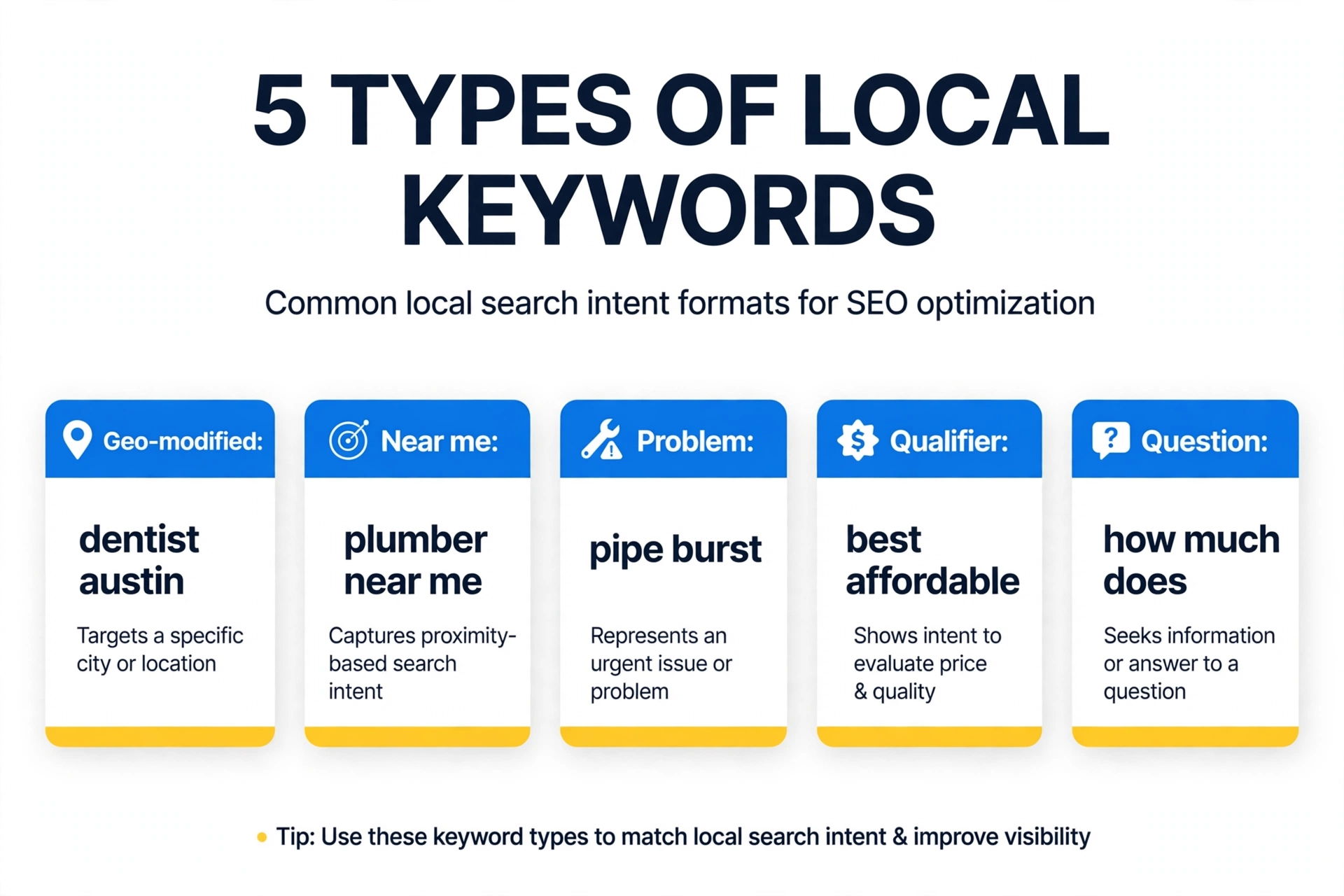
Not all local keywords behave the same. Knowing the types helps you find more of them and use them correctly:
Geo-modified keywords
Service plus an explicit place: “dentist Austin,” “pizza downtown Chicago.” These are the backbone of local SEO and the easiest to target with location pages.
“Near me” keywords
“Plumber near me,” “best coffee near me.” Google decides these by the searcher’s device location, not your content. You win them through profile strength, reviews, and proximity, not keywords on a page. More on that below.
Problem and symptom keywords
What customers experience, not what you call your service: “pipe burst,” “furnace not turning on,” “toothache.” These carry intense urgency and convert fast, yet competitors rarely target them well.
Qualifier keywords
Modifiers signaling specific intent: emergency, same day, affordable, best, licensed. “Emergency plumber Austin” and “affordable plumber Austin” are different searches with different customers.
Question keywords
“How much does drain cleaning cost in Austin?” These come straight from People Also Ask boxes and make excellent FAQ and blog content.
Implicit local keywords
Queries like “plumber” or “emergency plumbing” with no location attached. Google still shows local results because the intent is obviously local. Your profile and proximity do the heavy lifting here.
How Do You Find Keywords for Free?
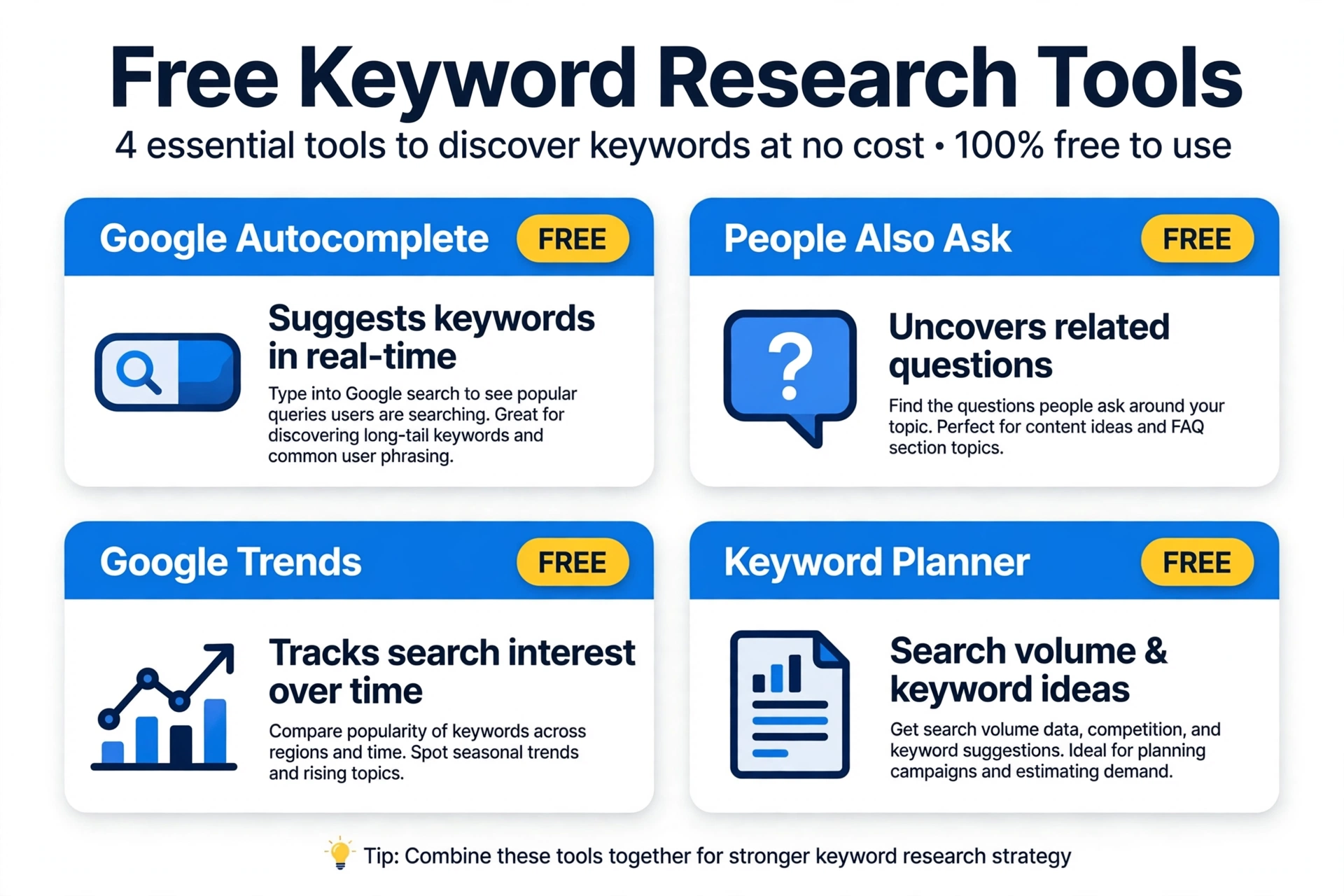
You do not need paid tools to build a strong local keyword list. Google itself is the best free research tool, because it shows you real searches in real time:
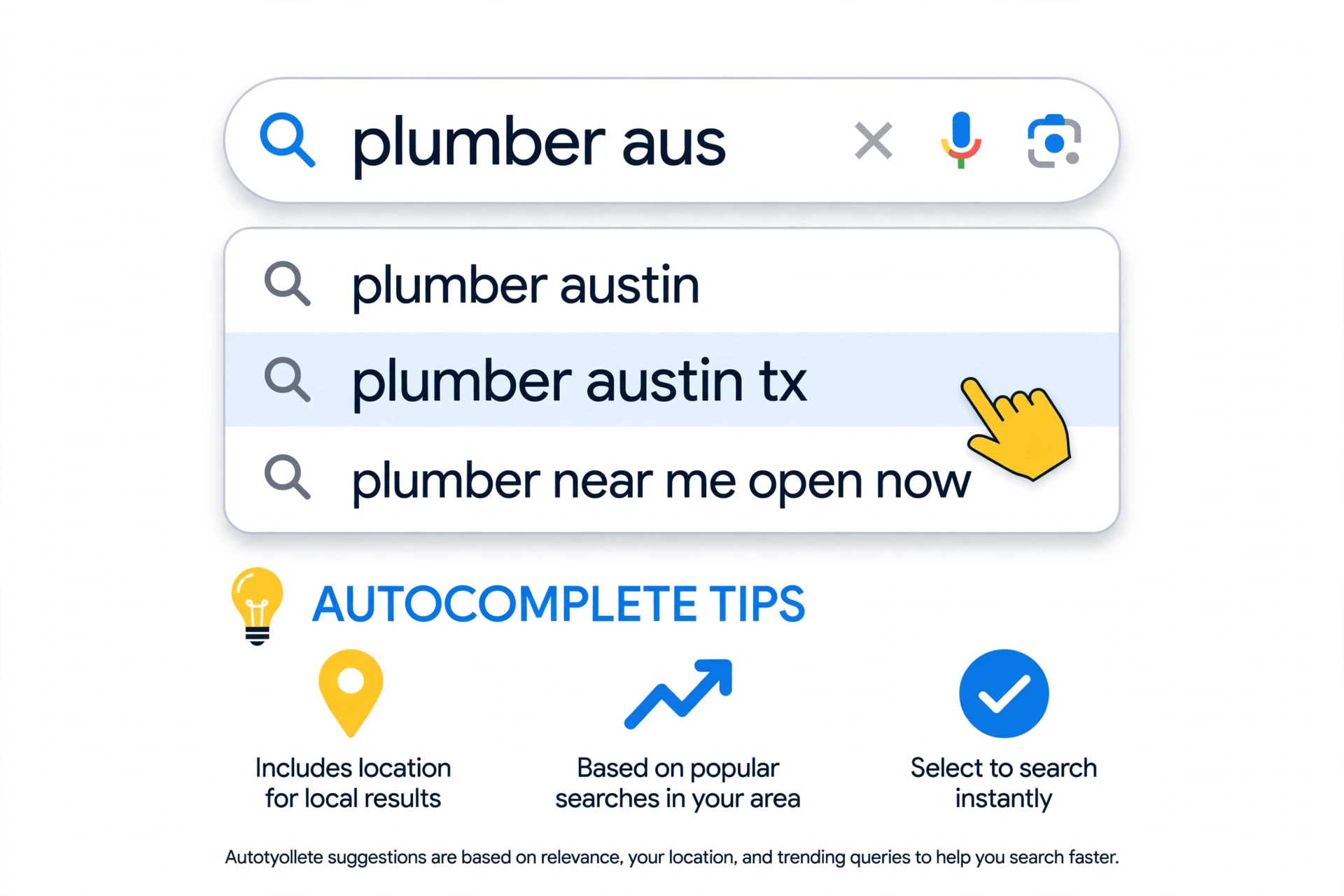
- Google Autocomplete: type your service plus your city and note every suggestion. Try service plus “near me,” service plus “best,” and half-typed phrases to trigger more.
- People Also Ask: click through the questions under the results. Each click reveals more. These are question keywords ready to become FAQ content.
- Related searches: scroll to the bottom of any result page. Google literally hands you more keyword ideas.
- Google Keyword Planner: free with a Google Ads account (no spend required). Set the location to your city for local volume estimates.
- Your own data: Google Search Console shows queries you already rank for, and your Google Business Profile insights show the searches that triggered your profile. Both are goldmines most businesses ignore.
- Google Trends: compare phrasing options (“plumber” vs. “plumbing service”) and spot seasonal demand in your region.
When should I pay for keyword tools? When free sources run dry or you need competitor data at scale. Tools like Semrush or Ahrefs show what rivals rank for and keyword difficulty scores, which free methods cannot. But most single-location businesses never need them.
How Do You Steal Ideas From Competitors?
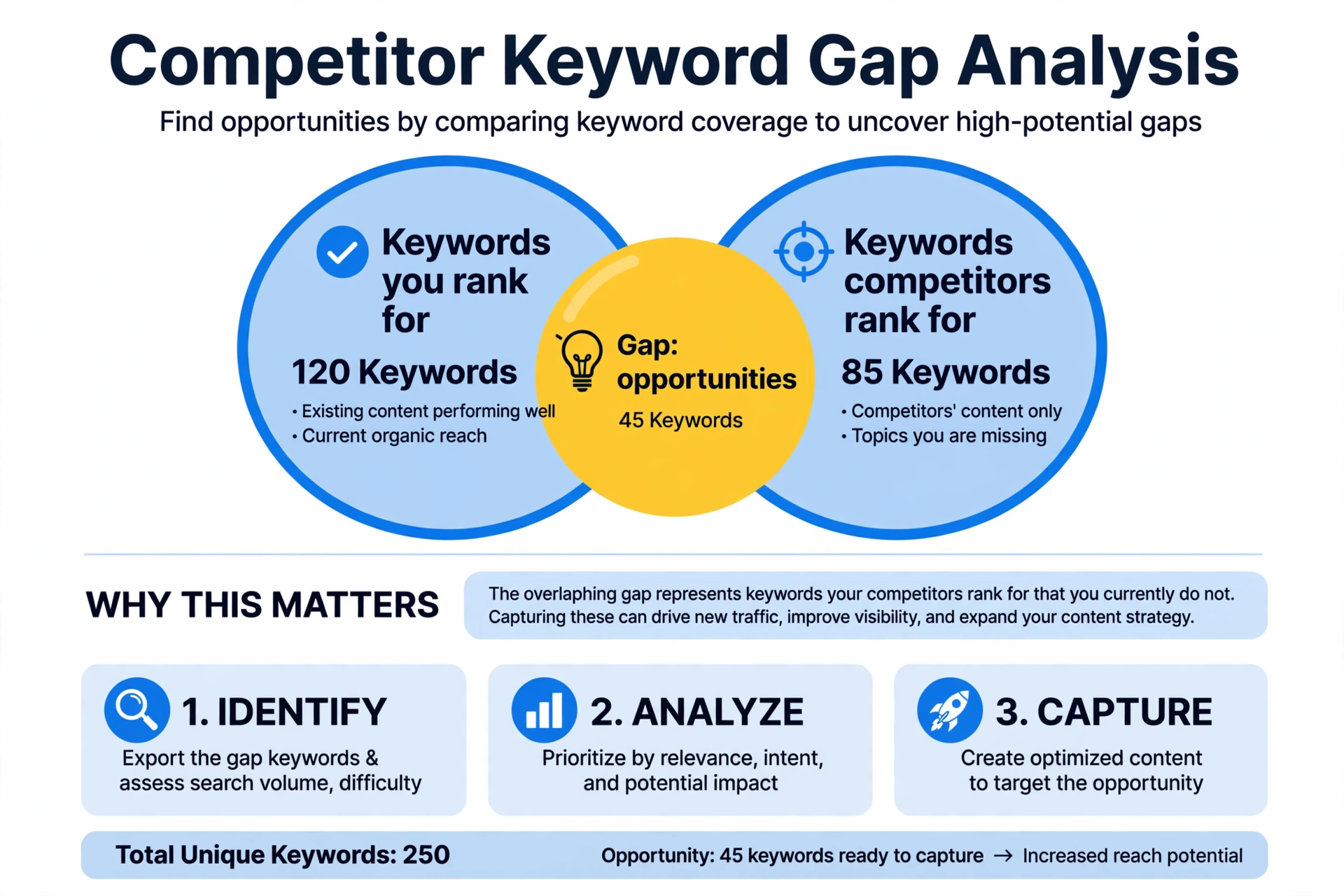
Your competitors already did the research. Search your main keywords and study the top three results. title tags, headings, service lists, and page URLs. The phrasing they repeat is the phrasing customers use.
Then look for the gaps. Note keywords where competitors rank weakly: thin pages, outdated content, or homepages ranking for service terms. Those are your openings. Also check competitor FAQs and blog titles; each one reveals a keyword they consider valuable.
One more source: competitor reviews. Customers describe their problems in plain language there. “My basement kept flooding” becomes your keyword “basement flooding repair,” phrased the way people actually think.
Can You Rank for “Near Me” Keywords?
Yes, but not by stuffing “near me” into your content. This is the most misunderstood part of local keyword research. “Near me” queries are resolved by the searcher’s location: Google shows businesses near the person searching. No page title tricks change that.
What wins “near me” searches instead: a complete verified Google Business Profile, a steady stream of reviews, accurate categories, and genuine proximity to the searcher. On-page keywords still matter for your service pages, but the “near me” part is won through profile strength. Stop writing “near me” into your headings; start earning reviews.
How Do You Map Keywords to Pages?
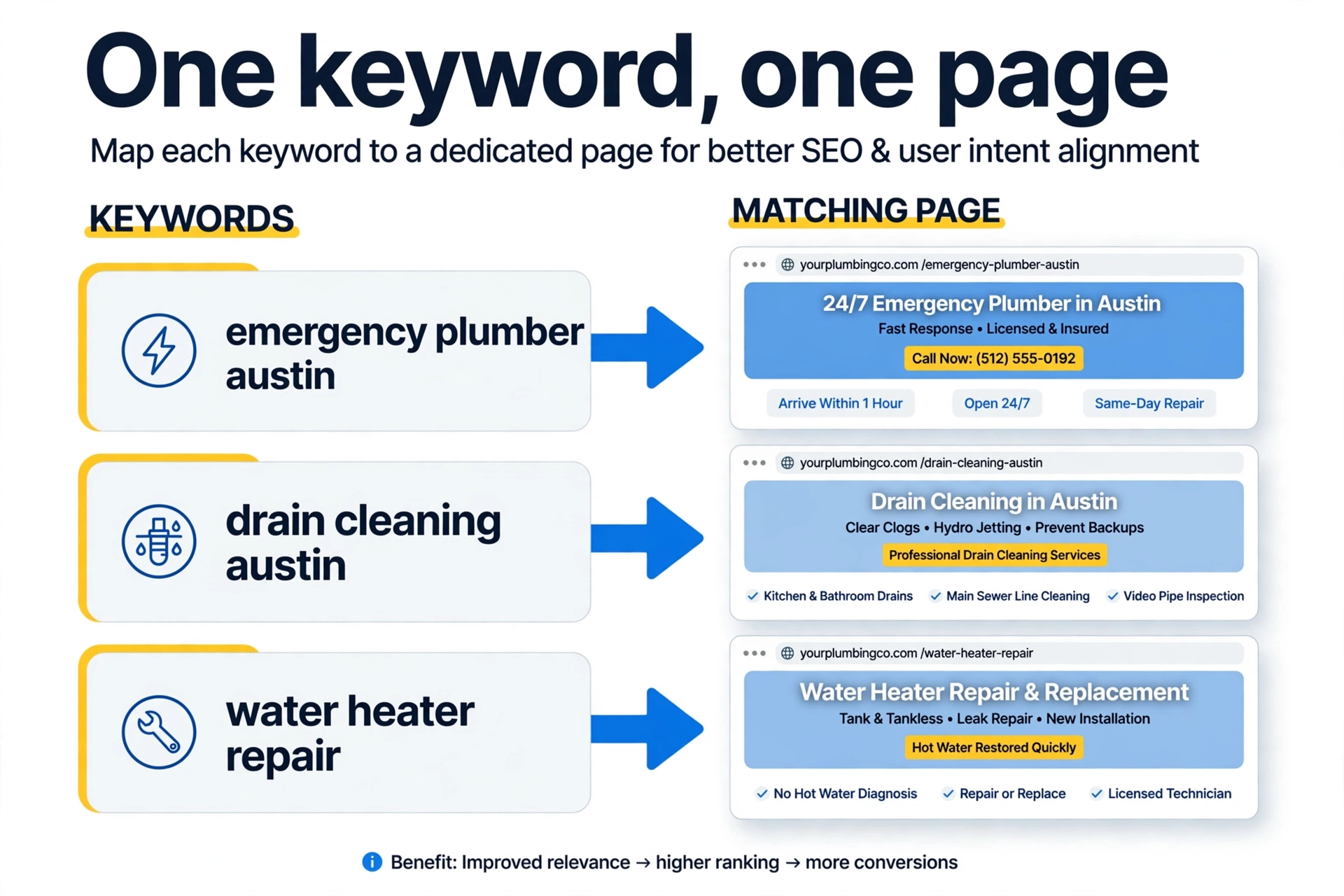
This is where keyword research becomes rankings. The rule is simple: one primary keyword per page. The page title, H1, and URL should reflect it. Related variants of the same intent can share that page, but distinct intents need distinct pages.
Example for a plumber: “emergency plumber Austin” gets its own page, “drain cleaning Austin” gets its own page, “water heater repair Austin” gets its own page. Each page goes deep on one service in one area. A single “services” page targeting all of them will rank for none of them.
Putting two similar keywords on separate thin pages backfires too. “Plumber Austin” and “plumbing services Austin” have the same intent; one strong page beats two weak ones. When in doubt, merge.
What Mistakes Should You Avoid?
- Targeting keywords with no local intent. A plumbing blog ranking nationally for “how pipes work” does not bring Austin customers.
- Creating pages for keyword variants of the same intent. This causes cannibalization: your pages compete with each other instead of with competitors.
- Ignoring search intent. “Plumber cost” is research; “emergency plumber” is a buyer. Send each to content that matches.
- Swapping city names on copy-pasted pages. Near-duplicate location pages get filtered. Each area page needs genuine local detail.
- Researching once and never again. Customer language shifts and new services create new keywords. Refresh your list quarterly.
Go deeper with Ahrefs’ guide to keyword intent and their AI keyword research guide.
What Is Your Next Step?
Finding local SEO keywords is a simple cycle: start with seed services, add location and intent modifiers, mine Google’s free suggestions, study competitors, and map each keyword to one page. Do this well and your content speaks the exact language your customers use. If you would rather have professionals run it, our local SEO services include full keyword research and page-by-page mapping. Local SEO Rankers has done this for businesses across dozens of local markets.
Want your keyword strategy done for you? Contact Local SEO Rankers for a free audit. We will find the keywords your competitors are missing and build you a page-by-page targeting plan.
Still Have Questions About Local SEO Keywords?
How many keywords should a local business target?
Most single-location businesses need 15 to 40 well-chosen keywords, each mapped to one page. Fewer excellent keywords beat a long list of irrelevant ones. Depth on each page matters more than count.
Are free keyword tools good enough for local SEO?
Usually yes. Google autocomplete, People Also Ask, Keyword Planner, Search Console, and your profile insights provide real local data for free. Paid tools add competitor analysis and difficulty scores when free sources run dry.
Should I include “near me” in my page titles?
No. Google resolves “near me” by the searcher’s location, not your content. Optimize the service and location keywords on your pages, and win “near me” searches through your Google Business Profile, reviews, and proximity.
How do I find keywords my competitors rank for?
Search your main keywords and study the top three results: their titles, headings, and service lists. Paid tools like Semrush or Ahrefs can export competitor keyword lists, but manual SERP analysis reveals plenty for free.
What is keyword cannibalization in local SEO?
When two of your pages target the same intent, they compete with each other and both rank worse. Fix it by mapping one primary keyword per page and merging pages that target intent-equivalent variants.
How often should I redo local keyword research?
Do a full refresh quarterly and spot-check monthly. Customer language evolves, competitors shift, and new services create new opportunities. Your Google Business Profile insights alone surface fresh queries every month.