I run a small repair shop in Leander, Texas. I fix things for folks who live within about twenty miles of my front door. Here is what I know about how my customers find me: they do not open a phone book, they do not drive around looking for signs, and they do not ask their neighbor first. They pull out their phone, usually while standing in their kitchen next to whatever just broke, and they type something like “repair shop near me.”
That is local SEO. It is the reason my phone rings. And if you run a local business of any kind, a plumber, a dentist, a cafe, a roofer, it is the reason your phone rings too, or the reason it stays quiet.
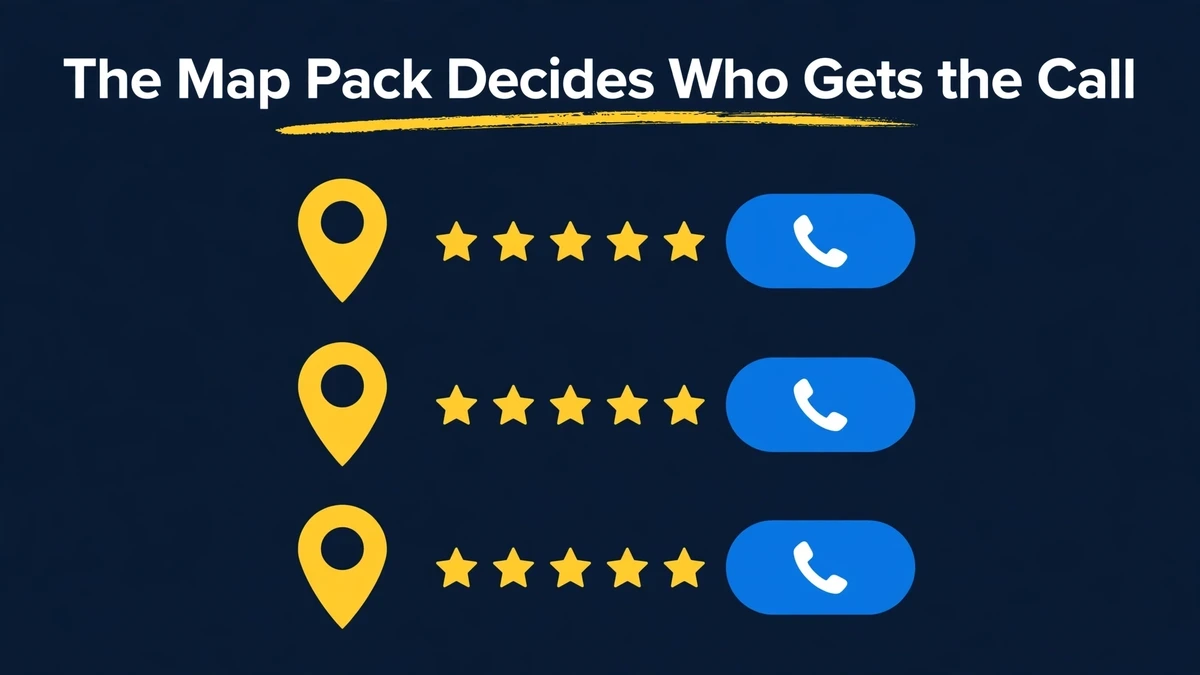
The short answer: Your customers search local first, and most pick from the three businesses in the map pack. Local SEO puts you in that top three, in front of people who are ready to buy, and it keeps working after you stop paying for ads.
People ask me all the time why local SEO is important to your business. The short answer is simple: your customers search local first, they decide fast, and they trust what Google shows them. If you are not there when they look, someone else gets the job. It really is that simple.
What Is Local SEO, in Plain Words?
Local SEO is making sure Google shows your business when someone nearby searches for what you do. That is the whole job, in one sentence. When a person in your town types “best tacos near me” or “emergency plumber Austin,” Google has to decide which businesses to show. Local SEO is the work that puts your name on that short list.
You show up in three places. First, the map pack, those three businesses with the map at the top of the results. Second, the regular organic results underneath. Third, your Google Business Profile, the box with your hours, your photos, your reviews, and the big Call button. Most customers never get past the first one.
What does Google actually look at?
Google says local results come down to three things: relevance, distance, and prominence. Relevance means your business matches what the person searched for. Distance means how close you are to them. Prominence means how well known you are, which Google judges from your reviews, your links, and how complete your information is.
You cannot move your shop closer to every customer. But relevance and prominence are yours to work on, and that is what local SEO does.
Why Do Your Customers Search Local First?
People do not search for fun. They search because something needs fixing, buying, or booking, and they want it done close to home. That is why local search is the most valuable traffic a small business can get. The person typing is not browsing. They are choosing.
The numbers back that up. In BrightLocal’s 2026 survey of 1,227 US consumers who had recently searched for a local business, 84% had searched online for a local business in the previous three months. More than half, 52%, started that search on Google Search, and another 9% started on Google Maps. Add it up and 61% of local searches begin on Google. And 71% used Google Search at some point during the search.
Here is the part that should make every business owner sit up: 75% of those people chose a business in under 30 minutes, and 72% looked at three or fewer businesses. That is not a long research project. That is a person with a problem picking from a tiny list, fast.
Think about your own habits. When your water heater dies, do you read ten websites? No. You check the top two or three, glance at the stars, and call one. Your customers do the same to you.
Most of those searches happen on a phone, while the person is standing in the room with the problem, not sitting at a desk doing research. Other 2026 local SEO statistics show the same pattern: local search is a daily habit now, not a sometimes thing, and the phone is where it happens.
How Does Local SEO Bring You Customers Who Are Ready to Buy?
Most marketing chases people who are not ready. A billboard talks to everyone driving past, including people who will never need you. A social media ad interrupts someone scrolling for fun. Local search is the opposite. The person already has the problem, already has the money, and is already looking for you. They just have not found you yet.
That is why local SEO matters more than almost any other marketing a small business can do. You are not convincing anyone. You are standing where the customer is already looking.
The scale of it is hard to overstate. Google handles more than 5 trillion searches a year, and Google Maps has over 2 billion monthly users around the world. An older Google figure, from back in 2018, put local intent at 46% of all Google searches. That number is old, and I am telling you it is old, but no newer official figure has replaced it, and the 2026 surveys point the same way: a huge share of everything people search for is something near them.
So the question is not whether people search locally. They do, by the billions. The question is whether your business is the one they find.
Here is what that journey looks like. The customer types the problem, Google shows three names, the customer checks the stars and the hours, and then they call one of them. They have already decided to spend the money before they ever talk to you. The only decision left is who gets it. Local SEO is how you become one of the three names they are choosing between, instead of the shop they never see.
What Happens If Your Business Does Not Show Up?
Here is the part nobody likes to hear. When your business does not show up in local search, you do not lose a click. You lose the call, the visit, and the job. The customer does not think, “That shop must be good, I will go find their website.” They call the shop that did show up. Your competitor gets the work, the review, and the repeat customer.
Remember that 72% of people look at three or fewer businesses. If you are sitting in fourth place, you might as well be in another state. Nobody scrolls that far when their sink is leaking.
And here is the good news hidden inside the bad news: most of your competitors are not doing this work either. Only about 35% of small businesses actively maintain their Google Business Profile, according to BrightLocal’s 2026 small business report. That means the field is wide open. The shop that fills out its profile, collects reviews, and keeps its information straight is already ahead of two out of three competitors before the day starts.
That gap is your opening. It will not stay open forever.
Local SEO vs Paid Ads: Which One Is Worth Your Money?
Every business owner asks me this one. Should I pay for ads, or should I do local SEO? Here is the honest comparison, the way I explain it to a friend.
| Channel | What it costs | How fast it works | How long it lasts | Who trusts it |
|---|---|---|---|---|
| Local SEO | Your time, or a monthly service | Weeks to months | Keeps working after the work is done | High, it is an earned ranking |
| Google Ads | Every click, every day | Same day | Stops the day you stop paying | Medium, people know it is an ad |
| Social media ads | Daily budget, plus creative | Same day | Stops the day you stop paying | Lower, it interrupts the scroll |
| Flyers and word of mouth | Printing and your time | Slow and uneven | Fades fast | High for word of mouth, low for flyers |
Ads rent attention. Local SEO builds something you own. The day you stop paying for ads, your phone goes quiet. The work you put into your profile, your reviews, and your website keeps bringing customers months later, without another dollar.
Ads still have a place. If you need jobs this week, run ads this week. But if you only run ads and never build local SEO, you are renting your customers forever. The smart play is both: ads for now, local SEO for always. If you want that foundation built properly, Local SEO Rankers’ local SEO service covers the profile, the website, and the citations together.
How Do Reviews and Your Google Business Profile Win Trust?
Your Google Business Profile is your free storefront. It is the first thing most customers ever see of your business: your photo, your hours, your phone number, and your stars. And the stars are doing more work than anything else on that page.
BrightLocal’s 2026 review survey, 1,002 US adults, says it plainly. 97% of consumers read reviews for local businesses, and 41% always read them, up from 29% just a year earlier. After reading reviews, 93% have gone on to make a purchase. A good review makes 85% of people more likely to use a business. A bad one puts off 77%.
And the bar keeps rising. Almost a third of consumers, 31%, will only use a business rated 4.5 stars or higher, nearly double the 17% from a year before. Almost half, 47%, will not even consider a business with fewer than 20 reviews. And 74% only trust reviews written in the last three months. An old five-star review from two years ago does not carry you anymore.
Google rewards a complete profile, too. According to Google’s own figures, customers are 2.7 times more likely to consider a business reputable when its profile is complete, 70% more likely to visit, and 50% more likely to consider buying. Complete profiles get seven times more clicks than incomplete ones. You can see the full set of Google Business Profile statistics for 2026 if you want every number in one place.
The ranking experts agree. In Whitespark’s 2026 Local Search Ranking Factors survey, 47 local SEO experts scored 187 factors, and Google Business Profile signals carried 32% of the map pack weight, the single biggest group. Review signals were second at 20%, up from 16% in 2023. Your primary category alone is the highest-weighted single factor. Read the full breakdown in this 2026 ranking factors guide.
Put it together and the picture is clear: the profile and the reviews are more than half of what decides who shows up. And both are things you can control without spending a dollar on ads. If your profile is half empty and your last review is from last year, you are handing customers to the shop down the road. A proper Google Business Profile management service keeps all of it handled: categories, photos, posts, and review replies.
One more thing about reviews: answer them. Every one, good or bad. Customers read the replies and judge you by them. A short, honest reply to a bad review does more for your reputation than ten perfect reviews nobody answered. It shows there is a real person behind the business, and that person cares.
What About AI Search? Does Local SEO Still Matter When ChatGPT Answers?
Maybe you have heard customers say they asked ChatGPT for a recommendation instead of Googling it. That is real, and it is growing fast. In BrightLocal’s 2026 review survey, 45% of consumers said they had used AI tools for local recommendations, up from just 6% the year before. In one year, AI went from a curiosity to the third most popular way people find a local business.
So does local SEO still matter? Yes, more than ever. Here is why. AI answers name far fewer businesses than Google Maps does. In BrightLocal’s September 2026 visibility study, which ran more than 200,000 local prompts for about 1,300 business locations, Google Maps named a tracked business in 66% of local searches. ChatGPT did it in 33%, Google AI Mode in 32%, and AI Overviews in 38%. The map still names you twice as often as the AI does.
That gap is the opportunity. AI tools are still new at local, and the businesses they name are the ones with the clearest, most consistent information. A 2026 roundup of local SEO statistics tracking Maps and AI side by side shows the same split: Maps is still the workhorse, AI is the rising challenger, and the winners in both are the businesses whose data is straight.
What do AI engines actually read about your business?
ChatGPT, Perplexity, and AI Overviews do not pick businesses out of thin air. They read the same signals Google reads: your name, address, and phone number matching everywhere, your reviews, your website content, and your schema markup. They cite businesses that are clear, consistent, and citable. That is answer engine optimisation, AEO, and generative engine optimisation, GEO. And here is the secret: it is the same work as local SEO. A clean profile, real reviews, consistent business data, and FAQ content that answers real questions in plain words is exactly what AI engines lift into their answers.
If you want that handled properly, Local SEO Rankers’ AEO and GEO service builds your business into the answers ChatGPT, Perplexity, and Google AI Overviews give. The businesses that get named in AI answers are the ones that did the local SEO work first.
What Does Local SEO Cost, and What Do You Get Back?
I am not going to quote you a fake price here, because the honest answer is that it depends on your town, your trade, and how much you do yourself. Your Google Business Profile is free. Fixing your name, address, and phone number everywhere is free. Asking a happy customer for a review is free. What costs money is your time, or paying someone to do it for you.
So think about it the other way. What does one lost job a week cost you? If a plumber loses one $300 job a week to the shop that ranks above him, that is over $15,000 a year walking past his door. Local SEO does not need to be cheap to be worth it. It needs to be cheaper than the customers you are already losing.
And what you get back is not just one job. It is calls, visits, direction requests, and reviews that bring the next customer, and the next one. A good review you earn this month is still working for you next year. That is the return: customers who came looking for you, which makes them the cheapest customers you will ever get.
It compounds, too. A job done well earns a review. That review lifts your ranking a little. The better ranking brings the next job, which earns the next review. Nobody else can buy that loop. An ad can buy a click today, but it cannot buy the review that brings you a customer next month. That is the real return on local SEO: work you do once that keeps paying you back.
What Should You Do First?
You do not need to do everything at once. Here is the order I would do it in, if this were my shop.
- Claim and complete your Google Business Profile. Every field: hours, services, photos, description, categories. This is free and it is the single biggest lever you have.
- Get the category right. Your primary category is the highest-weighted ranking factor there is. Pick the one that matches what you actually do, not the fanciest sounding one.
- Ask every happy customer for a review. Right after the job, while they are still smiling. A short text with the link is enough. Reviews are the second biggest ranking factor and the first thing customers read.
- Fix your name, address, and phone number everywhere. Your website, your profile, and every directory must match exactly. One wrong digit confuses Google and customers alike. That cleanup is what citation building does.
- Put your service and your city on your website. If you are a roofer in Leander, your pages should say so, in plain words, with the questions customers actually ask answered right there.
- Keep it going one hour a week. A new photo, a reply to a review, a post about a job. Consistency beats a one-time burst.
Do those six things and you are ahead of most of your town already. Then keep going. And check your numbers once a month: your profile shows you how many calls, direction requests, and searches you got, free. If the calls are climbing, the work is working. If they are flat, something needs attention. You do not need fancy software. The profile tells you what you need to know.
Frequently Asked Questions
Why is local SEO important to your business?
Because your customers search locally first and decide fast. Local SEO puts your business in front of people who are already looking for what you do, near you, right now.
Is local SEO worth it for a small business?
Yes. It is the highest-intent traffic a small business can get, and your Google Business Profile is free. Read this 2026 guide on whether local SEO is worth it for the full numbers.
How long does local SEO take to work?
A complete profile and a few reviews can move the needle in weeks. Competitive markets take three to six months of steady work. It compounds: the longer you do it, the harder you are to catch.
What is the Google map pack?
The map pack is the block of three businesses with a map that appears at the top of most local searches. It gets the most clicks, calls, and direction requests of any spot on the page.
Do I need a website for local SEO?
Your profile can rank on its own, but a website makes you far stronger. It gives Google more to rank, gives customers somewhere to land, and lets you answer their questions before they call.
How important are online reviews?
They are the second biggest ranking factor and the first thing customers read. In 2026, 97% of consumers read reviews, and almost half will not consider you if you have fewer than 20 of them.
Can local SEO help my business show up in AI search?
Yes. ChatGPT, Perplexity, and AI Overviews cite businesses with clear, consistent, citable information. That is the same profile, review, and content work as local SEO.
What is the difference between local SEO and regular SEO?
Regular SEO tries to rank you everywhere. Local SEO tries to rank you for people near you. It adds your profile, your map listing, your reviews, and your local citations to the work.
How much does local SEO cost?
Your profile is free. Your time is the main cost if you do it yourself. Paying an agency costs a monthly fee that varies by town and trade. Compare it against one lost job a week, and the math usually answers itself.
Can I do local SEO myself?
Yes, the basics are simple: complete your profile, get reviews, keep your details consistent, and answer customer questions on your site. An agency helps when you want it done faster or your market is competitive.
Bottom Line: Your Customers Are Already Searching. Be There When They Do.
That is why local SEO is important to your business: it is where your customers already are. They search on their phones, they pick from three names, they read the reviews, and they call. That is the whole buying process now, and it happens in under half an hour.
You cannot control who searches. You can control whether they find you. Fill out the profile, earn the reviews, keep your details straight, and answer the questions your customers are asking. Do that and the phone rings. Skip it and the shop down the road gets your customer.
If you want help getting found, that is what I do. Reach me on WhatsApp at +92 336 0378683, email hello@localseorankers.com, or visit localseorankers.com and tell me where your customers are. I will tell you straight what it will take to get you in front of them.