
Your website has 50,000 pages. A standard SEO checklist says “optimize your title tags.” You laugh, because that would take one person roughly two years.
That is the moment you discover enterprise SEO. It is not bigger SEO; it is a fundamentally different operating model for websites so large and complex that the standard playbook physically cannot work. Here is what it is and how it works.
The short answer: Enterprise SEO is the practice of optimizing large, complex websites (thousands to millions of pages) for search at scale. It differs from standard SEO through automation and templates instead of manual work, cross-team governance, advanced technical systems, and ROI measured in revenue rather than rankings.
What Is Enterprise SEO?
Enterprise SEO is the practice of optimizing large, complex websites for search at scale. Three things define it:
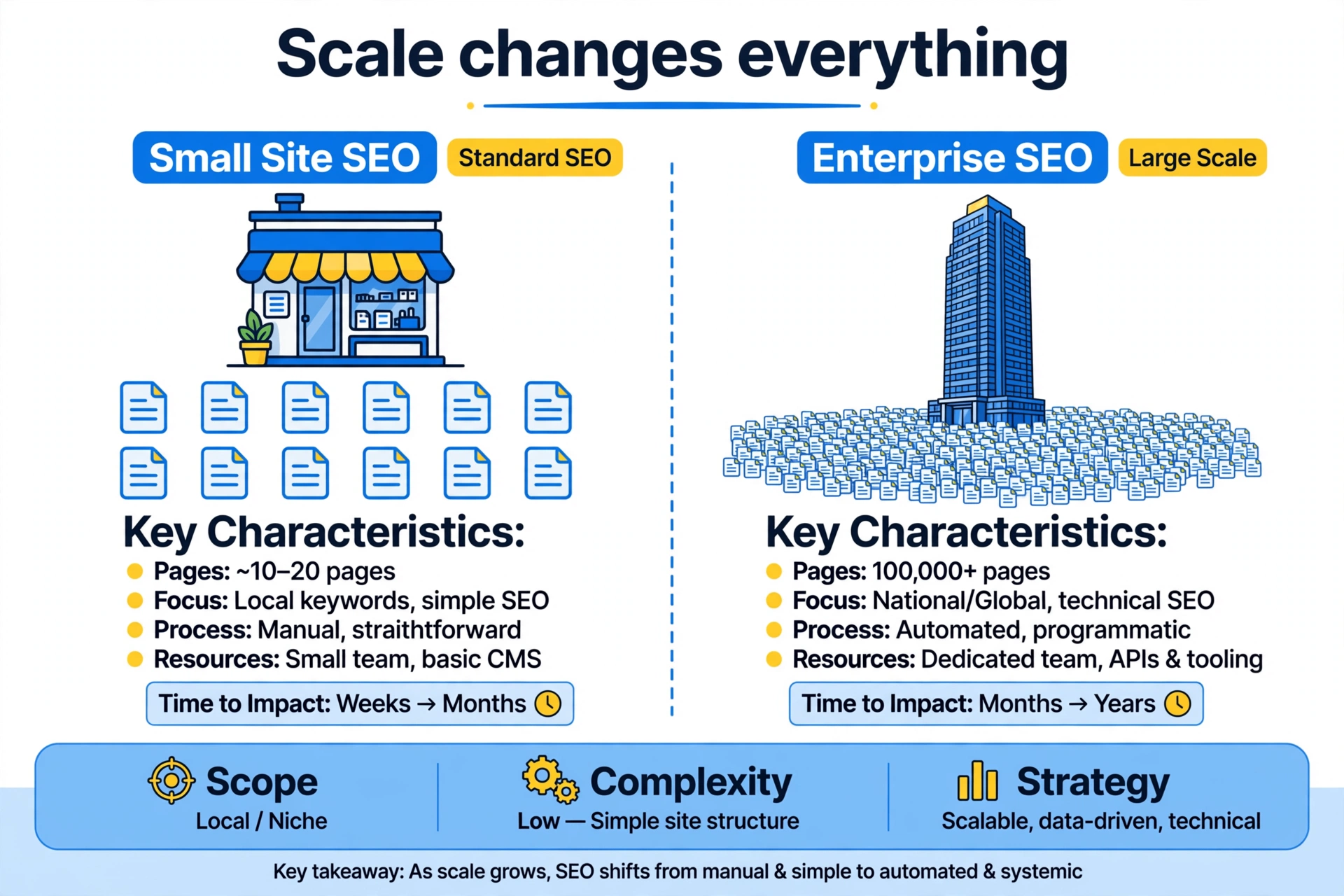
- Scale: thousands to millions of pages, too many to optimize by hand. You need systems, templates, and automation.
- Complexity: multiple teams, legacy technology, approval chains, sometimes multiple sites, regions, or languages.
- Competition: you are chasing head terms, the high-value keywords everyone wants, against well-funded rivals.
Here is the part most people get wrong: “enterprise” is not about your company’s size. A 12-page plumbing site is never enterprise SEO. A 15,000-page ecommerce store run by one marketing manager absolutely is. The label describes the website’s scale and complexity, not the logo on the building or the size of the marketing budget.
How Does Enterprise SEO Differ From Standard SEO?
| Dimension | Standard SEO | Enterprise SEO |
|---|---|---|
| Website scale | Dozens to hundreds of pages | Thousands to millions of pages |
| Primary focus | Content, keywords, on-page basics | Scalable systems, automation, governance |
| Workflow | Small team, fast iteration | Multiple teams, structured processes, approvals |
| Technical depth | Standard audits and fixes | Crawl budget, migrations, international, legacy stacks |
| Measurement | Traffic, rankings, leads | Revenue impact, pipeline, market visibility at scale |
| Biggest constraint | Visibility and authority | Coordination, technical debt, development resources |
The core SEO process is identical: keywords, content, technical health, links. What changes is that at enterprise scale, the hard part becomes coordination and execution, not knowing what to do. Standard SEO wins through speed and experimentation. Enterprise SEO wins through process, measurement, and persistence.
What Are the Biggest Enterprise SEO Challenges?
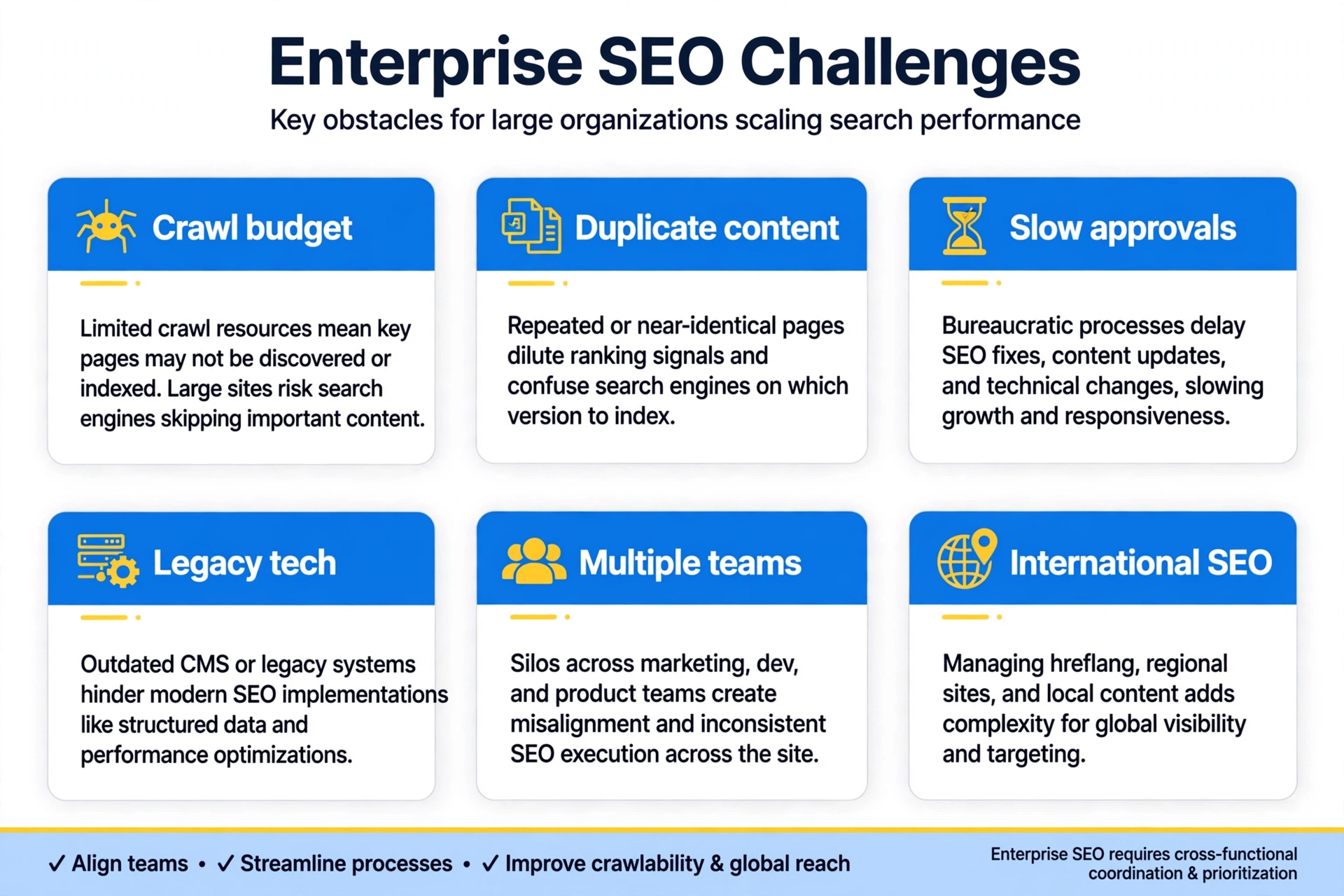
- Crawl budget waste: Google allocates limited crawl attention. Faceted navigation, infinite parameters, and bloated archives burn it on useless URLs while money pages wait.
- Duplicate and thin content: product variations, location templates, and legacy pages multiply near-duplicates that dilute rankings.
- Indexation at scale: getting the right 50,000 pages indexed, and the wrong 200,000 excluded, is a systems problem.
- Legacy technology: old CMS platforms, JavaScript rendering issues, and technical debt that predates the current team.
- Slow approvals: a technical fix that takes a freelancer an hour can take an enterprise three months through engineering, security, and legal review.
- Competing priorities: five teams with separate budgets and conflicting goals, all touching the same website.
- International complexity: hreflang, regional content, translation workflows, and regulatory differences across markets.
How Do You Execute SEO at Enterprise Scale?
You stop doing things by hand and start building machines that do them:
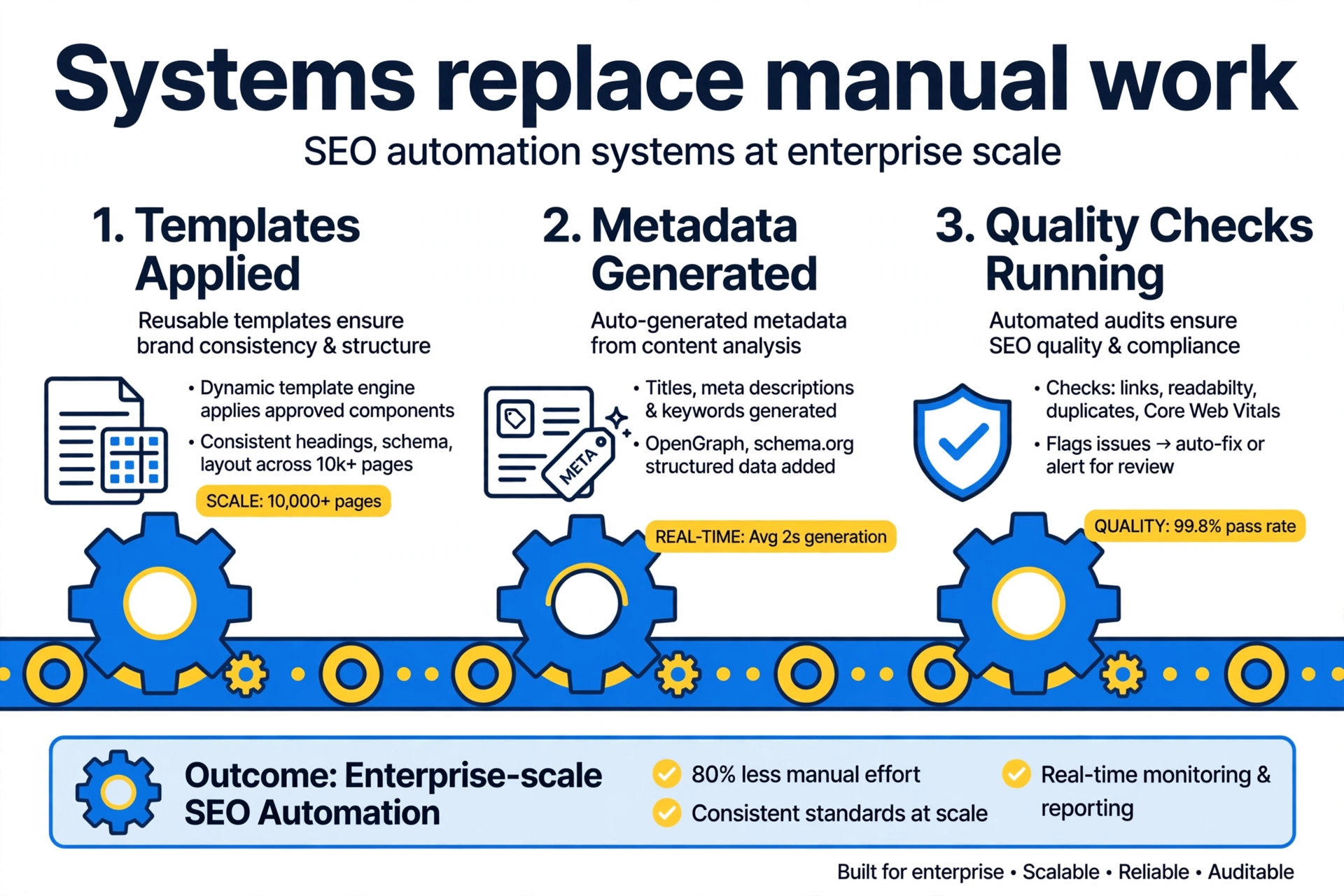
- Templates over manual work: title tags, meta descriptions, headings, and schema generated from page data through tested templates, with rules for exceptions.
- Automated quality checks: crawls that continuously monitor for broken links, duplicate titles, indexation drift, and Core Web Vitals regressions across the whole site.
- Prioritization systems: scoring models that rank pages and fixes by revenue impact, so limited engineering time goes where it matters most.
- Programmatic content: location and product pages generated from structured data, each with enough unique local detail to avoid thin-content filters.
- Controlled deployment: staging, testing, and phased rollouts for site-wide changes, because one bad template can break 100,000 pages at once.
The mindset shift: you are not optimizing pages anymore. You are building and maintaining the system that optimizes pages.
Why Does Governance Matter More Than Tactics?
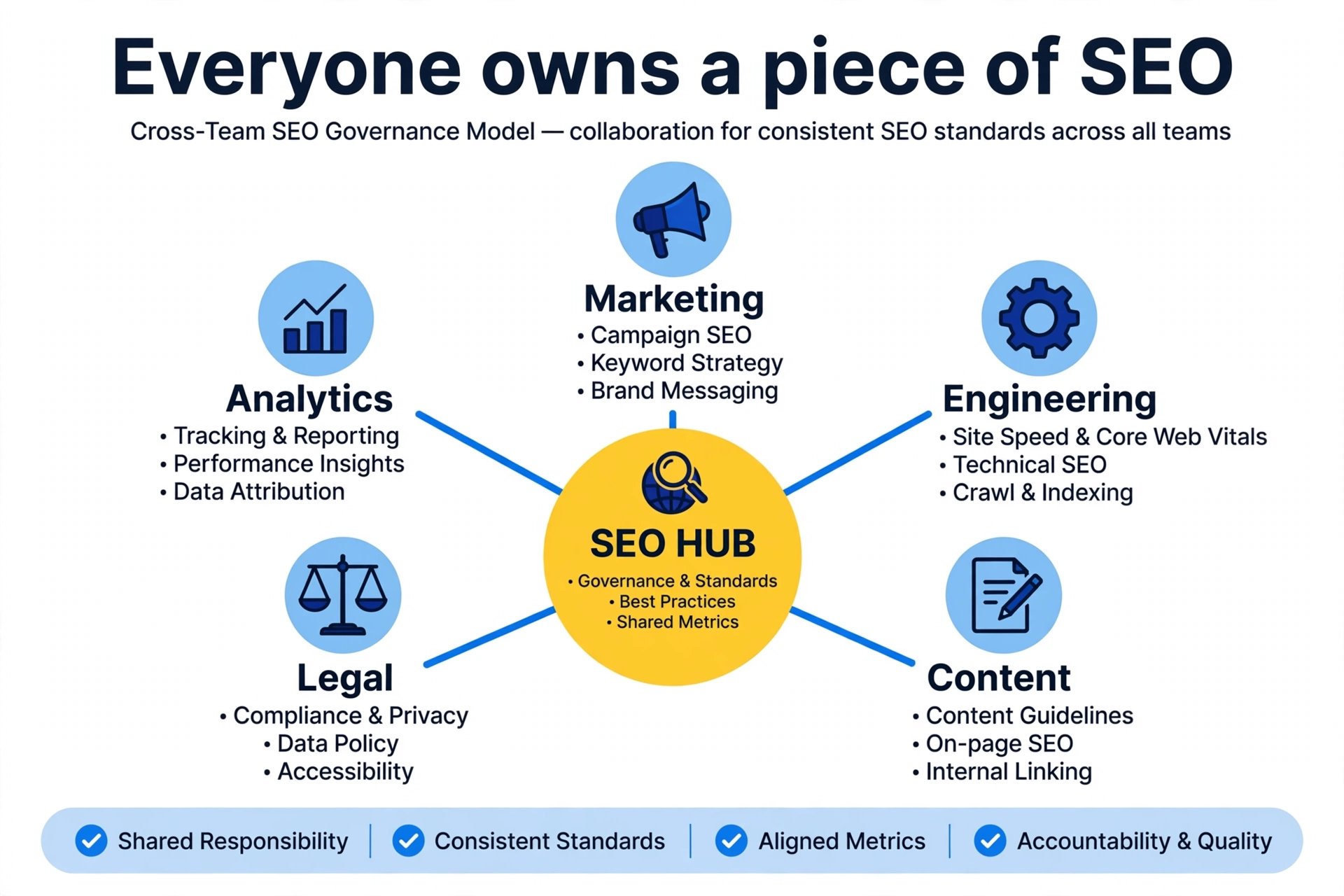
At enterprise scale, the best SEO strategy in the world fails without governance: clear ownership, documented standards, and processes that survive team changes. Who can publish? Who approves template changes? What happens when marketing wants speed and engineering wants stability?
Effective enterprise SEO governance includes an SEO council or center of excellence, documented standards for content and technical changes, training for non-SEO teams whose work affects search, and monitoring that catches violations before they compound. It is unglamorous and it is the difference between strategy and chaos.
Start small even at scale. Pilot governance on one business unit or region, prove the model with measurable wins, then expand confidently. Enterprise transformations that try to change everything at once usually change nothing at all.
Do small businesses need governance? Not like this. A solo owner is the entire governance structure. But the principle scales down: even a five-person team benefits from one documented checklist of SEO standards.
How Do You Measure Enterprise SEO ROI?
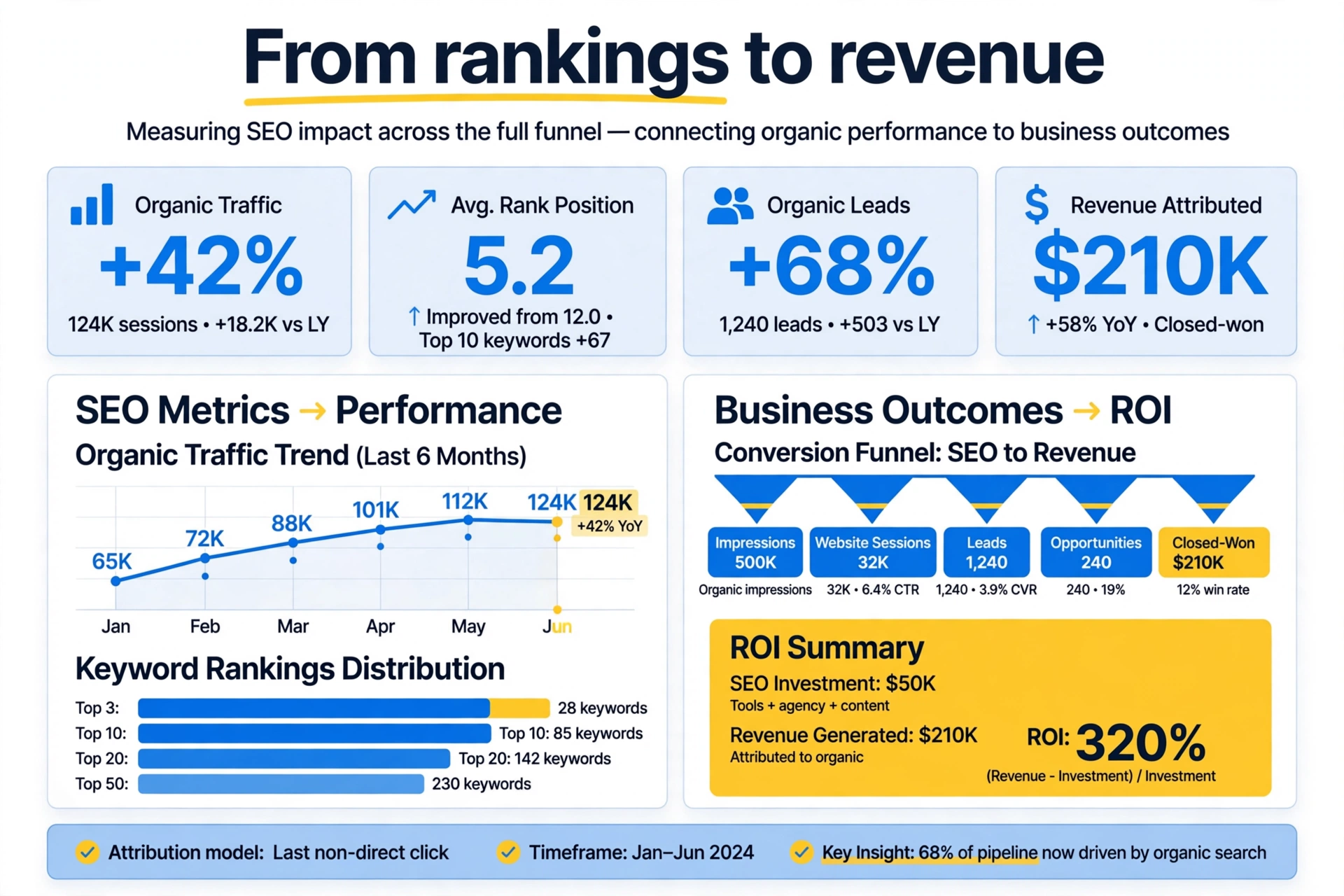
Rankings and traffic are activity metrics. At enterprise investment levels, leadership needs business outcomes: qualified pipeline, customer acquisition cost, revenue attributed to organic search. A 5 percent traffic lift on a site doing millions in organic revenue is a board-level number.
reporting that connects the chain: technical health to crawl efficiency to rankings to traffic to conversions to revenue. Enterprise SEO platforms and analytics integrations exist precisely because spreadsheets break at this scale. When you can show that organic search drives the largest share of trackable pipeline, budgets follow, and SEO earns its permanent seat at the strategy table.
When Should You Hire Enterprise SEO Help?
Bring in specialized help when organic visibility has plateaued despite internal effort, technical debt is blocking crawling and indexing, a site migration is approaching, or analytics cannot connect search to pipeline. These are the moments where enterprise-specific expertise pays for itself.
Expect retainers in the range of several thousand to tens of thousands per month, scaled to your complexity, and early movement in three to six months. The right partner handles crawl architecture, migrations, multi-region setups, and stakeholder alignment, not just keywords and content. Ask for case studies at your scale before signing anything. For businesses below enterprise scale, our local SEO services deliver the same rigor sized to your reality.
Read Search Engine Journal’s take on crawl budget and Google’s SEO Starter Guide for the foundations.
Is Enterprise SEO Your World?
If your website’s scale makes manual SEO physically impossible, you are already doing enterprise SEO whether you call it that or not. The answer is systems: templates, automation, governance, and measurement tied to revenue. Local SEO Rankers helps businesses of every size build SEO that scales with them.
Outgrowing standard SEO? Contact Local SEO Rankers for a free assessment. We will evaluate your site’s scale challenges and design a system that handles them.
Still Have Questions About Enterprise SEO?
What is the difference between enterprise SEO and regular SEO?
Same core principles, different operating model. Enterprise SEO handles thousands to millions of pages through automation, templates, cross-team governance, and advanced technical systems, while standard SEO works manually on smaller sites.
How many pages make SEO “enterprise”?
There is no fixed number, but the shift typically happens in the thousands of pages, when manual optimization becomes physically impractical. Complexity (teams, regions, legacy tech) can make even smaller sites enterprise-like.
How much does enterprise SEO cost?
Enterprise retainers typically range from several thousand to over twenty thousand dollars per month, scaled by content volume, technical complexity, and link building needs. The investment should tie to pipeline goals.
What is crawl budget in enterprise SEO?
The limited attention Googlebot gives your site. Large sites waste it on useless URLs (parameters, archives, duplicates) while important pages wait. Managing crawl budget means directing Google’s attention to pages that earn revenue.
Can small businesses use enterprise SEO tactics?
Selectively. Templates, systematic monitoring, and documented standards help at any size. But full enterprise governance and automation only pay off when scale makes manual work impossible.
How long does enterprise SEO take to show results?
Early movement typically appears in three to six months, with compounding gains after. Timelines stretch because changes must pass through approvals, engineering queues, and phased rollouts.